Jonathan says: In celebration of many things, including our own recent engagement, our friend's impending wedding, and the general gloriousness of early fall in Napa Valley, we decided to head for lunch to Thomas Keller's bistro Bouchon, located just down the street in Yountville from his more famous French Laundry. The Michelin Guide to Northern California had just awarded Bouchon a star despite being rather parsimonious in its distribution of awards to other San Francisco-area restaurants, and so we were especially eager to see what at Bouchon had warranted this treatment.
Seeb says: Up until the night before, I had thought of our lunch as a special advance celebration of Jonathan's birthday. Apparently, he had a larger plan in mind the whole time.
J: The restaurant itself is gorgeous, and decorated in classic French brasserie style: brass rails, mirrors on the walls, tiled floors, nouveau French paintings on the walls, and even a large potted plant in the middle. All told, very authentic. From the moment we sat down, the food was superb to match. The mini-baguette placed on our table was delicious, and the butter that accompanied it was superbly creamy and just a little bit sweet.
S: Loved the huge floor-to-ceiling potted plant in the middle of the seating area. I don't remember the tile exactly, but I get the feeling I didn't like it. The seat (velour or velvet, I think. red?) was comfortable, but the tables were lined up pretty close so that sliding in and out of the seat was tricky. And I was not the only woman who found this a challenge.
J: After much haggling, we initially decided to order a half carafe of a pinot grigio from a nearby (!) winery. When the waiter arrived, however, he strongly recommended the 2004 Domaine Vacheron Sancerre from the Loire Valley, and since I had been considering the Sancerre in the first place I fairly quickly agreed. Seebany, however, protested, arguing (quite correctly, as I readily admitted) that it was somewhat ridiculous to be ordering French wines while *sitting in Napa.* Nonetheless, in the end we opted for the Sancerre and were very happy that we did. The wine was light and crisp with hints of fruit and a finish reminiscent of black pepper, and it was delicious by itself and a wonderful complement to the seafood dishes that we decided to order.
S: To be precise, we were haggling over the amount of wine, not over the type. One of us would have to drive us back, after all.
My first course was not seafood, though. It would have come as a surprise to nearly anyone who knows me. I'm not the biggest fan of eggs, and I don't know much about the various types of cheese. But if there's anyone who could convert me with a quiche, it'd be Thomas Keller. The mushroom and roquefort quiche was just the right savory start. Not sulfury in smell or taste, but earthy from the mushrooms and the pungent cheese. But it was really the texture that made it different from just about any other quiche I've tried. Served in a small ramekin, the quiche was extremely custard-like. Fantastic, and all that *without* an overbearing egg taste. [Sadly, I don't remember the crust exactly, although I know it was not a typical flaky pie crust.] The richness actually made me wish for an instant for colder weather (!) that would do this warm comfort food justice. In fact it brought to mind exactly another dining moment in which French food was the ultimate comfort food - the coq au vin in the chocolately thick sauce we had last winter at Fringale. There's something about discovering comfort foods even though you never ate them as a child.
J: I ordered the rillettes aux deux saumons, essentially a spread of smoked and raw salmon preserved in a glass jar and covered with a layer of clarified butter (which the waiters skillfully removed). It was delicious in all of the ways that good salmon usually is, and moreover there was quite a bit of it. Seeb and I were both able to eat our fill before it had disappeared. The only minor slip-up in the service was that we were required to ask more than once before the waiters brought more bread for the rillettes. All told, not somehow as spectacular as Seeb’s quiche, but still very good.
As a main course I ordered the dish I had been eyeing (on the internet) for months, the moules au safran—basically moules frites (mussels and French fries) in a saffron and mustard sauce with hints of black and red pepper. The mussels were perfectly done, the sauce was deliciously spicy and more than a bit tangy, and the powerful aroma of saffron was a perfect complement to the mussels’ natural flavor. The pot in which the mussels were served was also impressively conceived; one corner of the pot was literally fenced off from the remainder in order to provide a space for dipping the mussels (and the fries) that wasn’t crowded by shells. And what fries—probably the best French fries I have ever eaten, better even than the duck fat fries at Hot Doug’s in Chicago (which are a favorite of many of this site’s bloggers). Perfectly salty, incredibly crispy, and not even terribly oily or greasy. The problem was that despite being the best fries I have ever tasted they were the least interesting thing on the table to eat, so we didn’t finish them.
***
S: So, here it is December 15th, and wouldn’t you know, I’ve taken so long to write now that I had to ask Jonathan to remind me what my main course was. Scallops with parsnip puree. Of course, once he said it I instantly remembered the texture of the parsnips and the scallops. The dish was very mild flavored, the scallops just a little buttery sweet and the parsnips as I imagine parsnips must usually be, (not having them often), a nice background flavor, really meant to let the scallops be the stars.
And then on to the dessert. Jonathan and I shared a lemon tart. Normally I would prefer something richer and, except in summertime, less fruity. But with the weather and the heft of the rest of the meal (lunch, i.e. lighter) it was a good choice. Chris had told Jonathan that Keller considered this lemon tart to be the apotheosis of this dessert; he believed that he had perfected the recipe and would never change it. This may well be, but I don’t think that we’re huge fans of lemon tart. Or perhaps we were just too stuffed from previous courses.
But one thing worth mentioning that is not about Bouchon, per se, ;) is that after lunch we walked a little ways up the road back to where we’d passed by the French Laundry. Took a look around at their little patio area and the iconic blue door, of course. Across the street was a small garden of three sets of four rows of vegetables (all labeled) that they grow and use at the restaurants. To view them all you have to step off the sidewalk and into the dirt, so don’t wear your absolute best pair of shoes to French Laundry or Bouchon.
I hadn’t heard of such specific varieties and strains. The garden certainly wasn’t large enough to supply the restaurant night after night, so I don’t know if it was a showcase garden, or if they only use these items as garnish. There were some really beautiful little “jingle bell peppers” ripe on the stalks that were very picturesque. I imagine a little goes a long way with those. All in all, a fun way to spend the afternoon.
Friday, December 15, 2006


Monday, December 04, 2006
Dinner with Friends
The weather in Chicago was almost as cold as Reggie Ball's performance in the ACC Championship game, but it was nothing that couldn't be warmed up by a some good food and wine. Dinner with John and Jonathan proved to be the bright spot between dreadful performances by my favorite teams.
We began the night with an amuse of Fried Oysters with two sauces - chive aioli and roasted red pepper. Stephanie has prepared these oysters in the past, and they were just as good as usual. Next, we made good use of a recent house-warming gift from Charlie and Lauren by serving escargots in their traditional bowls. The snails were topped with an equally-traditional garlic butter and proved rather tender and tasty. For the main course, I braised rabbit in white wine and rabbit jus and served it with buttered egg noodle "tagliatelle." The rabbit was moist and tender, and the noodles, from Del Cecco, proved more satisfying than the standard egg noodles. We concluded with delightful treats provided by John - including goose supreme, fromage d'affinois, Humboldt Fog, and Bleu d'Agur - and some excellent foie gras secretly imported into Chicago by some to-remain-nameless friends. I would mention that the blue cheese was particularly stunning, but then it would be even harder to get than it already is (because, of course, as soon as something is approved by Cask 79 its sales jump).
Wines for the evening were provided by our guests. We began with a 2004 Domaine Vacheron Sancerre that readers of this blog would already know of if Seebany had finished her post about Bouchon. The wine, which Jonathan and Seebany had shared at Bouchon, was both racy and rich, allowing it serve as both complement and foil for the buttery snails. Next we enjoyed the accidentally overchilled (my bad) Domaine Saint-Martin Marsannay Les Grands Vignes 2004 imported by Patrick Lesec. Lesec is a well-respected negociant known more for his Rhones than his Burgundies, and this bottle, as it warmed, showed both the grace of a pinot noir and the earthy core of a syrah. It was really excellent both with the rabbit and alone. The cheese course was accompanied by a wine sourced from John's personal cellar, the 2003 Chateau de Myrat Sauternes. I had tasted this wine without food previously, and it seemed even more profound when paired with the goose supreme and blue cheese. Full of botrytis yet perfectly balanced, it was quintessential Sauternes. We ended the night with some post-prandial YouTubing and a bottle of Chateau Henye Tokaji Furmint 2000. While it didn't have the botrytis of the Myrat (it probably should have been served first), it did offer an excellent purity of tree fruit that was refreshing after an evening of such almost but not quite gluttony.
We began the night with an amuse of Fried Oysters with two sauces - chive aioli and roasted red pepper. Stephanie has prepared these oysters in the past, and they were just as good as usual. Next, we made good use of a recent house-warming gift from Charlie and Lauren by serving escargots in their traditional bowls. The snails were topped with an equally-traditional garlic butter and proved rather tender and tasty. For the main course, I braised rabbit in white wine and rabbit jus and served it with buttered egg noodle "tagliatelle." The rabbit was moist and tender, and the noodles, from Del Cecco, proved more satisfying than the standard egg noodles. We concluded with delightful treats provided by John - including goose supreme, fromage d'affinois, Humboldt Fog, and Bleu d'Agur - and some excellent foie gras secretly imported into Chicago by some to-remain-nameless friends. I would mention that the blue cheese was particularly stunning, but then it would be even harder to get than it already is (because, of course, as soon as something is approved by Cask 79 its sales jump).
Wines for the evening were provided by our guests. We began with a 2004 Domaine Vacheron Sancerre that readers of this blog would already know of if Seebany had finished her post about Bouchon. The wine, which Jonathan and Seebany had shared at Bouchon, was both racy and rich, allowing it serve as both complement and foil for the buttery snails. Next we enjoyed the accidentally overchilled (my bad) Domaine Saint-Martin Marsannay Les Grands Vignes 2004 imported by Patrick Lesec. Lesec is a well-respected negociant known more for his Rhones than his Burgundies, and this bottle, as it warmed, showed both the grace of a pinot noir and the earthy core of a syrah. It was really excellent both with the rabbit and alone. The cheese course was accompanied by a wine sourced from John's personal cellar, the 2003 Chateau de Myrat Sauternes. I had tasted this wine without food previously, and it seemed even more profound when paired with the goose supreme and blue cheese. Full of botrytis yet perfectly balanced, it was quintessential Sauternes. We ended the night with some post-prandial YouTubing and a bottle of Chateau Henye Tokaji Furmint 2000. While it didn't have the botrytis of the Myrat (it probably should have been served first), it did offer an excellent purity of tree fruit that was refreshing after an evening of such almost but not quite gluttony.
Sunday, December 03, 2006
Country Style Cream of Leek Soup
We finally imported some photos from our camera, and I wanted to post a photo of the Country Style Cream of Leek Soup that I blogged about a few weeks ago. Click on the title to link to that post.

This is a cream-based sausage and leek soup, and it turned out better than I expected. The perfect soup for a cold Saturday night.
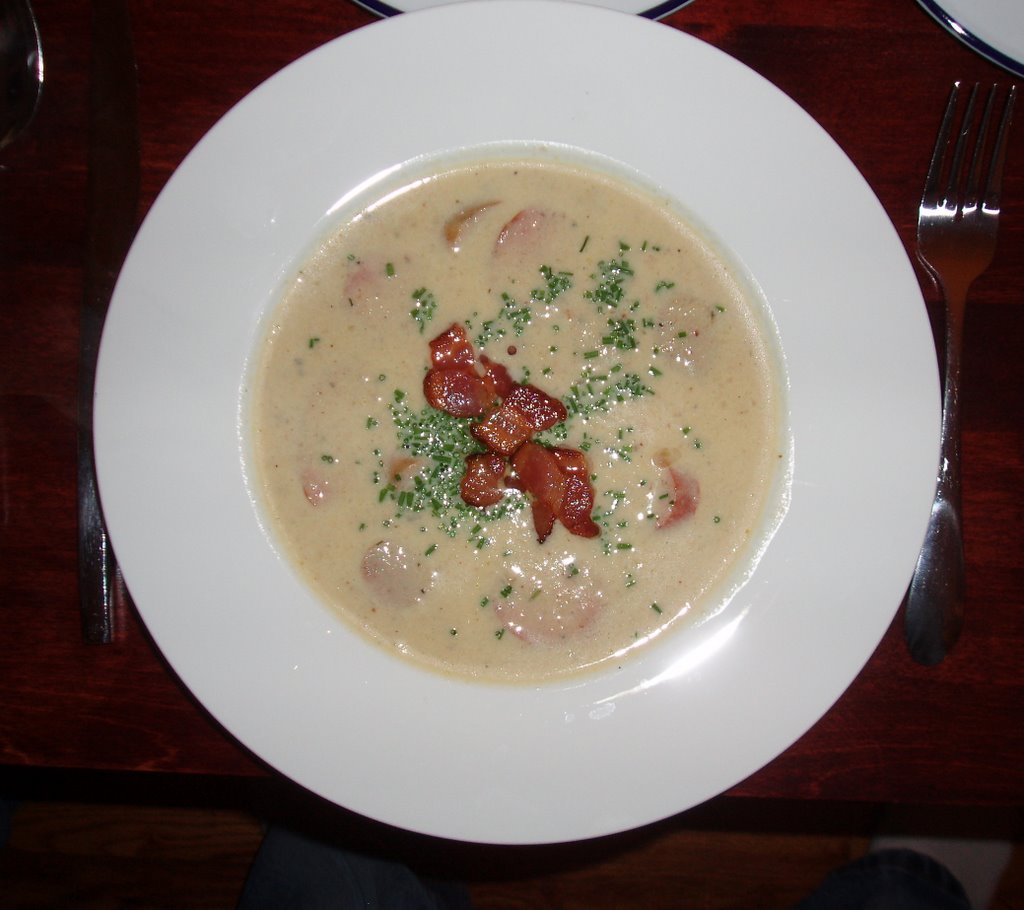
This is a cream-based sausage and leek soup, and it turned out better than I expected. The perfect soup for a cold Saturday night.
Thursday, November 30, 2006
This Guacamole Haas No Avocado
The courts have just told us that a burrito is not a sandwich, and now we'll find out if guacamole legally has to contain avocado. A Los Angeles woman is suing Kraft foods over its "guacamole dip" for misleading advertising because the dip contains only 2% avocados. The article is here.
Interestingly, the article notes that peanut butter must contain at least 90% peanuts according to FDA regulations. Frankly, I'm surprised that it's that high. Many European countries take the contents of their food products very seriously. I wonder if this is the beginning of greater federal regulation in this country.
Interestingly, the article notes that peanut butter must contain at least 90% peanuts according to FDA regulations. Frankly, I'm surprised that it's that high. Many European countries take the contents of their food products very seriously. I wonder if this is the beginning of greater federal regulation in this country.
Monday, November 13, 2006
Saturday, November 04, 2006
How do you know it's fall? Sausage soup and pumpkin ice cream
Yesterday, Chris announced that he wanted to go to Lincoln Square to buy sausages today. Lincoln Square is an older but charming Chicago neighborhood about fifteen minutes from our house. It has an obvious German influence. Every year -- like many towns -- they have an Octoberfest with good German sausages and beer. The "square" is like any small-town downtown, with plenty of small shops and tree lined parking. They also have metered lots, which is great because you don't have to pay $20 to park for half-an-hour. We've eaten at some interesting, genuine biergartens, but today we had Thai food. Sorry.
In any event, the real purpose of our trip today was to visit Han's Delicatessen Meyer, Chris's favorite German grocery. While Chris was taking the MPRE this morning, I studied our numerous and varied cook books for a sausage-related recipe. I settled on Country Style Cream of Leek Soup from Splendid Fare: The Albert Stockli Cookbook. My dad picked up the book -- which was published in 1970 -- for Chris at a book consignment sale. According to the book jacket, Stockli "made New York's Four Seasons restaurant celebrated around the world." I don't know about that, but I do know that his recipes are influenced by his European training and, particularly, his Swiss heritage. Hence, Country Style Cream of Leek Soup, which is simmering as I type (with a few of my slight modifications):
Chop and saute four slices of thick bacon for 5-10 minutes. Remove some bacon for garnish later. Roughly chop and add to the saute: three leeks, half an onion, three cloves garlic. Add a bouquet garni (parsley, thyme, basil), salt and pepper (light on the salt). Add four cups of chicken stock or canned chicken broth (I am using canned broth because Chris has been slack on making stock lately.) and bring to a simmer.
In a cast iron pan, brown several sausages, such as smoked farmer sausages, bauernwurst, cervelat, Kielbasa, pig's knuckles, or small pork link sausages. We're using two each of thuringer and nuernberger sausages. Add the sausages (whole) to the simmering stock. Simmer uncovered for about 45 minutes or until the leeks are soft and well cooked. (I haven't gotten past this point in cooking, but I'm sure Chris will blog about the finished product later.) Remove the sausage, pour the soup into a blender (or, if you're smart enough to have one, use an emersion blender. And, I strongly recommend buying one. They're so easy to use and clean.) Puree the soup until smooth. Return to stove and stir in one cup of cream. Yum!! Heat, but do not boil. Slice the sausage and return it to the soup. Serve sprinkled with chopped chives and the reserved bacon.
For dessert, we're having pumpkin ice cream. I know it sounds kind of strange, and I was skeptical at first, but the unfrozen custard (which is cooling in the fridge) is great. I can't wait to freeze it:
Halve two small pie pumpkins (not the same as carving pumpkins), remove seeds, and roast until soft or microwave in a dish with about half an inch of water for ten minutes. Scoop pulp into a bowl and add 1 tsp vanilla paste or extract (I recommend buying the real stuff, it makes a huge difference). If you don't want to cook the pumpkin you can also buy canned unsweetened pumpkin puree. Refridgerate the puree for a couple of hours.
Whisk 1 1/2 cups of cream and 1/2 cup of brown sugar over the stove, let warm on medium heat for about ten minutes, stirring often. Whisk five egg yolks, 1/4 cup of brown sugar, 1 tsp pumpkin pie spice (or cinnamon, nutmeg, allspice, ginger), until the sugar begins to dissolve. Slowly pour about 1/2 cup of the warm cream mixture in to the eggs, whisking, to temper the eggs. Pour the egg mixture in to the warm cream and simmer, stirring, for about five minutes or until the custard coats a spoon. Cool over an ice bath, then whip the pumpkin puree into the mixture. Refridgerate for three to twenty-four hours (longer results in better texture), then freeze according to the ice cream manufacturer directions.
So, we're having Country Style Cream of Leek Soup for dinner, and homemade pumpkin ice cream for dessert. This is what I call a real fall meal! I can't wait!
In any event, the real purpose of our trip today was to visit Han's Delicatessen Meyer, Chris's favorite German grocery. While Chris was taking the MPRE this morning, I studied our numerous and varied cook books for a sausage-related recipe. I settled on Country Style Cream of Leek Soup from Splendid Fare: The Albert Stockli Cookbook. My dad picked up the book -- which was published in 1970 -- for Chris at a book consignment sale. According to the book jacket, Stockli "made New York's Four Seasons restaurant celebrated around the world." I don't know about that, but I do know that his recipes are influenced by his European training and, particularly, his Swiss heritage. Hence, Country Style Cream of Leek Soup, which is simmering as I type (with a few of my slight modifications):
Chop and saute four slices of thick bacon for 5-10 minutes. Remove some bacon for garnish later. Roughly chop and add to the saute: three leeks, half an onion, three cloves garlic. Add a bouquet garni (parsley, thyme, basil), salt and pepper (light on the salt). Add four cups of chicken stock or canned chicken broth (I am using canned broth because Chris has been slack on making stock lately.) and bring to a simmer.
In a cast iron pan, brown several sausages, such as smoked farmer sausages, bauernwurst, cervelat, Kielbasa, pig's knuckles, or small pork link sausages. We're using two each of thuringer and nuernberger sausages. Add the sausages (whole) to the simmering stock. Simmer uncovered for about 45 minutes or until the leeks are soft and well cooked. (I haven't gotten past this point in cooking, but I'm sure Chris will blog about the finished product later.) Remove the sausage, pour the soup into a blender (or, if you're smart enough to have one, use an emersion blender. And, I strongly recommend buying one. They're so easy to use and clean.) Puree the soup until smooth. Return to stove and stir in one cup of cream. Yum!! Heat, but do not boil. Slice the sausage and return it to the soup. Serve sprinkled with chopped chives and the reserved bacon.
For dessert, we're having pumpkin ice cream. I know it sounds kind of strange, and I was skeptical at first, but the unfrozen custard (which is cooling in the fridge) is great. I can't wait to freeze it:
Halve two small pie pumpkins (not the same as carving pumpkins), remove seeds, and roast until soft or microwave in a dish with about half an inch of water for ten minutes. Scoop pulp into a bowl and add 1 tsp vanilla paste or extract (I recommend buying the real stuff, it makes a huge difference). If you don't want to cook the pumpkin you can also buy canned unsweetened pumpkin puree. Refridgerate the puree for a couple of hours.
Whisk 1 1/2 cups of cream and 1/2 cup of brown sugar over the stove, let warm on medium heat for about ten minutes, stirring often. Whisk five egg yolks, 1/4 cup of brown sugar, 1 tsp pumpkin pie spice (or cinnamon, nutmeg, allspice, ginger), until the sugar begins to dissolve. Slowly pour about 1/2 cup of the warm cream mixture in to the eggs, whisking, to temper the eggs. Pour the egg mixture in to the warm cream and simmer, stirring, for about five minutes or until the custard coats a spoon. Cool over an ice bath, then whip the pumpkin puree into the mixture. Refridgerate for three to twenty-four hours (longer results in better texture), then freeze according to the ice cream manufacturer directions.
So, we're having Country Style Cream of Leek Soup for dinner, and homemade pumpkin ice cream for dessert. This is what I call a real fall meal! I can't wait!
Monday, October 23, 2006
Domaine Saint-Damien Les Souteyrades Gigondas 2003
We picked up some lamb shoulder this weekend, and I braised it tonight in red wine, potatoes, mushrooms, carrots, and celery. Sadly the store was out of baguettes, so much good jus went unsopped. The lamb immediately called to mind a Rhone wine, so I picked up this bottle from the southern portion of that region. While it was rather ripe and round for an old world wine, it showed a nice balance of earth and acidity to pair well with the food. American wineries would be well-served in studying wines such as this, which show the value of rich fruit and soft texture when combined with length, structure, and tannin.
Saturday, October 21, 2006
Sweets & Savories
Last Sunday, Chris and I went to Sweets & Savories for brunch. Chris has been wanting to try this place for a while, and I thought brunch would be a fun but affordable way to see what we thought about it. I made reservations through Open Table and sent him an e-vite as a surprise.
The restaraunt is small, to say the least. There were probably fifteen tables. Decor is minimal and is mostly brown and pink. We arrived and were seated promptly at a table by the front window, looking out onto the street. To our surprise, there were several large parties at tables pushed together, including what looked like a baby shower or birthday party for an infant, complete with baby blue baloons tied to the chairs. Otherwise, the restaraunt was not overly full.
Our waiter was nice enough and knowledgeable about the food. Sunday brunch is a three course prix fixe menu for only $16.00. For this, you receive various scones and muffins and are given choices of: 1) drinks, including tea, coffee, mimosas and bloody marys; 2) soup, salad or fruit; and 3) an entree.
Chris ordered the curried potato soup and duck confit hash with poached eggs and a lemon hollandaise sauce. He requested champagne in lieu of a mimosa, and was offered a presseco, which was fresh and bright. I ordered a bloody mary, as well as the arugula salad and soft scrambled eggs with white truffle oil.
Chris's soup was not "curried" so much as it was a warm vichyssoise. It was creamy and rich, and just wonderful, with a hint of truffle. The arugula salad was also great -- lemony and nutty. Chris really loved his duck confit hash (which I did not taste), and the poached eggs in lemon sauce were out of this world. They were perfectly cooked, and the lemon added just the right touch of spark. My soft scrambled eggs were also nice --served over brioche -- but the bread was soggy and the "white truffle" was non-existent. Over all, the food was solid and I would return for that.
That said, our service was simply atrocious. We were brought our soup and salad promptly, and after we had each taken one bite, someone who appeared to be a food runner approached our table and informed us that our entrees were ready and asked if we minded having them served immediately. Chris said yes, we actually did mind, and the food runner said he couldn't do anything, our food was coming out. He was quite rude about it, and he and Chris bantered briefly. He insisted that he was going to bring the entrees out despite our request to wait. Chris then asked about our muffins and scones, which had not yet been brought out, though they are listed as the first course on the prix fixe menu. The food runner very brusquely said he would go and get them if we wanted them. He disappeared and shortly thereafter returned with the scones, but, thankfully, not the entrees.
Our entrees were ultimately delivered after we finished our soup and salad course, as we requested. The food itself was solid, if not terribly creative. The disappointment in this meal was the service, which was astonishingly bad -- e.g., trying to bring our entrees with the salad course, not bringing the "first" course until askd, not refilling our water even once. But, I can live with bad service. Sometimes it happens. Here, the service was downright rude. Chris later had a nice conversation with our actual waiter, but I was not able to get beyond the poor service. While Chris would like to return for a dinner, I would not.
In sum, the food was solid, brunch prices are more than reasonable, but service was terrible. If you're in it for the food and don't care about the service, go for it.
The restaraunt is small, to say the least. There were probably fifteen tables. Decor is minimal and is mostly brown and pink. We arrived and were seated promptly at a table by the front window, looking out onto the street. To our surprise, there were several large parties at tables pushed together, including what looked like a baby shower or birthday party for an infant, complete with baby blue baloons tied to the chairs. Otherwise, the restaraunt was not overly full.
Our waiter was nice enough and knowledgeable about the food. Sunday brunch is a three course prix fixe menu for only $16.00. For this, you receive various scones and muffins and are given choices of: 1) drinks, including tea, coffee, mimosas and bloody marys; 2) soup, salad or fruit; and 3) an entree.
Chris ordered the curried potato soup and duck confit hash with poached eggs and a lemon hollandaise sauce. He requested champagne in lieu of a mimosa, and was offered a presseco, which was fresh and bright. I ordered a bloody mary, as well as the arugula salad and soft scrambled eggs with white truffle oil.
Chris's soup was not "curried" so much as it was a warm vichyssoise. It was creamy and rich, and just wonderful, with a hint of truffle. The arugula salad was also great -- lemony and nutty. Chris really loved his duck confit hash (which I did not taste), and the poached eggs in lemon sauce were out of this world. They were perfectly cooked, and the lemon added just the right touch of spark. My soft scrambled eggs were also nice --served over brioche -- but the bread was soggy and the "white truffle" was non-existent. Over all, the food was solid and I would return for that.
That said, our service was simply atrocious. We were brought our soup and salad promptly, and after we had each taken one bite, someone who appeared to be a food runner approached our table and informed us that our entrees were ready and asked if we minded having them served immediately. Chris said yes, we actually did mind, and the food runner said he couldn't do anything, our food was coming out. He was quite rude about it, and he and Chris bantered briefly. He insisted that he was going to bring the entrees out despite our request to wait. Chris then asked about our muffins and scones, which had not yet been brought out, though they are listed as the first course on the prix fixe menu. The food runner very brusquely said he would go and get them if we wanted them. He disappeared and shortly thereafter returned with the scones, but, thankfully, not the entrees.
Our entrees were ultimately delivered after we finished our soup and salad course, as we requested. The food itself was solid, if not terribly creative. The disappointment in this meal was the service, which was astonishingly bad -- e.g., trying to bring our entrees with the salad course, not bringing the "first" course until askd, not refilling our water even once. But, I can live with bad service. Sometimes it happens. Here, the service was downright rude. Chris later had a nice conversation with our actual waiter, but I was not able to get beyond the poor service. While Chris would like to return for a dinner, I would not.
In sum, the food was solid, brunch prices are more than reasonable, but service was terrible. If you're in it for the food and don't care about the service, go for it.
Tuesday, October 10, 2006
Food, Law, and Culture Panels
A while back I published a Call for Papers for a panel devoted to food and the law at the upcoming Law, Culture, and Humanities conference at Georgetown University. I got an excellent response and am forming two panels on the subject. Here are the abstracts for the papers:
J. Amy Dillard
Assistant Professor of Law
University of Baltimore
School of Law
“Sloppy Joe, Slop, Sloppy Joe”: How USDA Commodities Dumping Destroyed the National School Lunch Program
Alice Waters, the godmother of the organic, whole food movement, has set the considerable resources of her Chez Panisse Foundation to the task of reforming school lunch in Berkeley, California, while working within the confines of the National School Lunch Program (NSLP). First funded by Congress in 1946, the NSLP combined two post-Depression Era objectives: 1) assist with the health of the nation’s children, and 2) ensure a market for farmers. The Department of Agriculture has used the NSLP to turn the nation’s school lunchrooms into a commodities dumping ground that has produced a glut of obese children and an expanding agribusiness that processes whole foods into nutritional nightmares.
This paper will explore the history of the NSLP and its complex relationship with USDA commodities, will examine the agribusiness of converting commodities into unhealthy lunchroom food, and will conclude by discussing the cultural challenges faced by the organic, whole food movement for bringing healthy food to a land where “latte-drinking, sushi-eating, Volvo-driving” freaks are excoriated by social conservatives.
*******
James Smith
John Byrd Martin Chair of Law
University of Georgia School of Law
Genetically modified pollen drifting onto the field of a neighboring farm may cause substantial harm. If the bystanding farmer is growing non-genetically modified crops, she may suffer a pecuniary loss due to genetic ‘pollution.’ If the pollen is patented, the patentee may also claim harm stemming from the unauthorized distribution of its proprietary genetic material. Disputes arising from pollen drift present classic legal questions arising under the law of neighbors and classic economic questions broached most famously by Ronald Coase in his essay on The Problem of Social Cost. The application of the Coase Theorem and its most applicable corollary strongly suggest that: 1) balancing rules under nuisance law should be applied on a case-by-case basis to determine whether any particular genetic polluter should be liable for damages caused by pollen drift; and 2) most bystanding farmers should have viable defenses to patent infringement. Venerable legal principles applied to this new problem suggest the same two conclusions. Proving both propositions provides a textbook demonstration for the usefulness of economic analysis and solves a world-wide multi-billion dollar legal problem.
******
Morgan L. Holcomb
Visiting Assistant Professor
University of Minnesota Law School
The local food movement has taken root (or perhaps taken root again). Witness books such as The Omnivore’s Dilemma (Pollan) and Eat Here (Halweil), activists taking on school lunches (Alice Waters revamping the Berkeley public school cafeteria), and the proliferation of farmers markets in almost all regions of the country.
This local food movement evidences a new or renewed interest in where our food comes from. Some farmers hope that it also means a renewed interest in keeping farms as “family farms” and a renewed economic commitment to do so. But what is meant by the term “family farm”? Shall we include large-scale commodity farms, or is “family farm” a proxy for something else? Perhaps by “family farm” we intend something other than simply any farm owned by a family.
This paper will begin by exploring what we mean by “family farm.” It will then go on to address what role will the tax code plays in our complicated agricultural system. Finally, the paper will address whether the tax code in fact save the family farm, and if saving the family farm a goal worth achieving.
******
Charlene Elliott
Assistant Professor
School of Journalism and Communication
Carleton University
In 2005, the Supreme Court of Canada ruled on Quebec’s long-standing law that prohibits the sale of yellow margarine. While the precise colour of margarine may seem trivial, the dispute carries on a century-old tradition in Canada of placing margarine in the legal (and lobbyist’s) limelight.
Margarine presents a long and bizarre legal history which opens the door for probing both the notion of legislative intent and the belief in a product’s communicative potential. The buttery impostor has been banned, outlawed, bootlegged, taxed and colour-coded—and even implicated in the Canadian Constitution
Inspired by Arjun Appadurai’s (1988) claim that ‘objects have social lives’, this analysis provides a legal ‘biography’ of margarine in Canada from 1886 to present. It details how the product has become the site of contestation, negotiation and special interest claims, and how the evolving regulation of margarine reflects some surprisingly consistent social realities.
******
Jonathan M. Gutoff
Associate Professor of Law
Roger Williams University School of Law
Under the Common Law, certain animals were classified as “royal” and were preserved for the sovereign as part of his or her prerogative. However, while salmon were recognized to be “great fish” they were not considered to be royal fish. I propose to use the case of sturgeon and salmon to explore the relationship between law and culture. Specifically, my plan is to investigate how the culinary and social distinction between sturgeon and salmon in the medieval period was reflected in the development of the legal distinction. Then, and this is why this case study may prove quite interesting, I hope to show how, in turn, the legal distinction in early-modern and modern times was reflected in the social and culinary position of sturgeon and salmon.
******
Patrick Baude
Ralph F. Fuchs Professor of Law and Public Service
Indiana University – Bloomington
Memory and the Twenty-First Amendment.
The Twenty-First Amendment (1) repeals Prohibition and (2) allows states to prohibit the transportation or importation of intoxicating liquors. Justice Stevens, dissenting from a recent Supreme Court opinion somewhat limiting state bans on importation, observed that the Court’s decision would “seem strange indeed to the millions of Americans who condemned the use of ‘demon rum.”’ This is a sensible thing to say about Prohibition but quite an odd thing to say about an amendment repealing Prohibition. His comment was especially powerful, however odd, in light of the implication that he had personal memory of this particular bit of legislative history. In fact, one can remember that history as a condemnation of strong drink or as a condemnation of the corruption created by the ban itself. Which memory one privileges will determine whether the penumbra of the Amendment is “wet” or “dry.” This paper traces the link between that history and a number of current questions, such as: (1) Can parents allow their twenty-year old children a glass of wine? (2) Can women be forbidden to drink because they might be pregnant? (3) Can sleeping pills be banned because they sometimes cause automobile accidents?
******
Christopher J. Buccafusco
University of Chicago
A Culture of Hospitality: Social Norms and Intellectual Property Among Chefs
American law offers little in the way of intellectual property protection to chefs’ creative recipes. Nonetheless, an informal system of social norms exists among chefs that serves to promote recipe innovation, assign credit to creative chefs, and inhibit rampant copying. This paper will examine the history of these quasi-IP norms and the culinary profession’s overarching “culture of hospitality.” It will attempt to determine whether the existence of such norms made the low-IP situation possible or whether they developed in response to a lack of legal protection. Finally, it will consider whether such a system is uniquely possible in the culinary profession or whether it can shed light on other areas of cultural property.
J. Amy Dillard
Assistant Professor of Law
University of Baltimore
School of Law
“Sloppy Joe, Slop, Sloppy Joe”: How USDA Commodities Dumping Destroyed the National School Lunch Program
Alice Waters, the godmother of the organic, whole food movement, has set the considerable resources of her Chez Panisse Foundation to the task of reforming school lunch in Berkeley, California, while working within the confines of the National School Lunch Program (NSLP). First funded by Congress in 1946, the NSLP combined two post-Depression Era objectives: 1) assist with the health of the nation’s children, and 2) ensure a market for farmers. The Department of Agriculture has used the NSLP to turn the nation’s school lunchrooms into a commodities dumping ground that has produced a glut of obese children and an expanding agribusiness that processes whole foods into nutritional nightmares.
This paper will explore the history of the NSLP and its complex relationship with USDA commodities, will examine the agribusiness of converting commodities into unhealthy lunchroom food, and will conclude by discussing the cultural challenges faced by the organic, whole food movement for bringing healthy food to a land where “latte-drinking, sushi-eating, Volvo-driving” freaks are excoriated by social conservatives.
*******
James Smith
John Byrd Martin Chair of Law
University of Georgia School of Law
Genetically modified pollen drifting onto the field of a neighboring farm may cause substantial harm. If the bystanding farmer is growing non-genetically modified crops, she may suffer a pecuniary loss due to genetic ‘pollution.’ If the pollen is patented, the patentee may also claim harm stemming from the unauthorized distribution of its proprietary genetic material. Disputes arising from pollen drift present classic legal questions arising under the law of neighbors and classic economic questions broached most famously by Ronald Coase in his essay on The Problem of Social Cost. The application of the Coase Theorem and its most applicable corollary strongly suggest that: 1) balancing rules under nuisance law should be applied on a case-by-case basis to determine whether any particular genetic polluter should be liable for damages caused by pollen drift; and 2) most bystanding farmers should have viable defenses to patent infringement. Venerable legal principles applied to this new problem suggest the same two conclusions. Proving both propositions provides a textbook demonstration for the usefulness of economic analysis and solves a world-wide multi-billion dollar legal problem.
******
Morgan L. Holcomb
Visiting Assistant Professor
University of Minnesota Law School
The local food movement has taken root (or perhaps taken root again). Witness books such as The Omnivore’s Dilemma (Pollan) and Eat Here (Halweil), activists taking on school lunches (Alice Waters revamping the Berkeley public school cafeteria), and the proliferation of farmers markets in almost all regions of the country.
This local food movement evidences a new or renewed interest in where our food comes from. Some farmers hope that it also means a renewed interest in keeping farms as “family farms” and a renewed economic commitment to do so. But what is meant by the term “family farm”? Shall we include large-scale commodity farms, or is “family farm” a proxy for something else? Perhaps by “family farm” we intend something other than simply any farm owned by a family.
This paper will begin by exploring what we mean by “family farm.” It will then go on to address what role will the tax code plays in our complicated agricultural system. Finally, the paper will address whether the tax code in fact save the family farm, and if saving the family farm a goal worth achieving.
******
Charlene Elliott
Assistant Professor
School of Journalism and Communication
Carleton University
In 2005, the Supreme Court of Canada ruled on Quebec’s long-standing law that prohibits the sale of yellow margarine. While the precise colour of margarine may seem trivial, the dispute carries on a century-old tradition in Canada of placing margarine in the legal (and lobbyist’s) limelight.
Margarine presents a long and bizarre legal history which opens the door for probing both the notion of legislative intent and the belief in a product’s communicative potential. The buttery impostor has been banned, outlawed, bootlegged, taxed and colour-coded—and even implicated in the Canadian Constitution
Inspired by Arjun Appadurai’s (1988) claim that ‘objects have social lives’, this analysis provides a legal ‘biography’ of margarine in Canada from 1886 to present. It details how the product has become the site of contestation, negotiation and special interest claims, and how the evolving regulation of margarine reflects some surprisingly consistent social realities.
******
Jonathan M. Gutoff
Associate Professor of Law
Roger Williams University School of Law
Under the Common Law, certain animals were classified as “royal” and were preserved for the sovereign as part of his or her prerogative. However, while salmon were recognized to be “great fish” they were not considered to be royal fish. I propose to use the case of sturgeon and salmon to explore the relationship between law and culture. Specifically, my plan is to investigate how the culinary and social distinction between sturgeon and salmon in the medieval period was reflected in the development of the legal distinction. Then, and this is why this case study may prove quite interesting, I hope to show how, in turn, the legal distinction in early-modern and modern times was reflected in the social and culinary position of sturgeon and salmon.
******
Patrick Baude
Ralph F. Fuchs Professor of Law and Public Service
Indiana University – Bloomington
Memory and the Twenty-First Amendment.
The Twenty-First Amendment (1) repeals Prohibition and (2) allows states to prohibit the transportation or importation of intoxicating liquors. Justice Stevens, dissenting from a recent Supreme Court opinion somewhat limiting state bans on importation, observed that the Court’s decision would “seem strange indeed to the millions of Americans who condemned the use of ‘demon rum.”’ This is a sensible thing to say about Prohibition but quite an odd thing to say about an amendment repealing Prohibition. His comment was especially powerful, however odd, in light of the implication that he had personal memory of this particular bit of legislative history. In fact, one can remember that history as a condemnation of strong drink or as a condemnation of the corruption created by the ban itself. Which memory one privileges will determine whether the penumbra of the Amendment is “wet” or “dry.” This paper traces the link between that history and a number of current questions, such as: (1) Can parents allow their twenty-year old children a glass of wine? (2) Can women be forbidden to drink because they might be pregnant? (3) Can sleeping pills be banned because they sometimes cause automobile accidents?
******
Christopher J. Buccafusco
University of Chicago
A Culture of Hospitality: Social Norms and Intellectual Property Among Chefs
American law offers little in the way of intellectual property protection to chefs’ creative recipes. Nonetheless, an informal system of social norms exists among chefs that serves to promote recipe innovation, assign credit to creative chefs, and inhibit rampant copying. This paper will examine the history of these quasi-IP norms and the culinary profession’s overarching “culture of hospitality.” It will attempt to determine whether the existence of such norms made the low-IP situation possible or whether they developed in response to a lack of legal protection. Finally, it will consider whether such a system is uniquely possible in the culinary profession or whether it can shed light on other areas of cultural property.
Monday, October 09, 2006
A Pork Filled Weekend
After an eye exam on Saturday (apparently all of this graduate schooling isn't good for the eyes), Stephanie and I stopped into a small Latin grocer and picked up a couple of pork cuts not seen at the yuppie markets. That night we roasted a saddle of pork with root vegetables. The saddle is the part on the top of the animal where the loins come together. It is like two very thick pork chops connected in the middle by the backbone. I had a bottle of Dr. H. Thanisch Wehlener Sonnenuhr Riesling Kabinett 2004 open from the previous night that matched superbly. Kabinett is the driest of Germany's sweet rieslings, but it is still far too sweet for Stephanie's palate. It was an excellent wine, with stone fruit flavors, a wild honey sweetness, and a pleasantly lingering acidity.
Last night I braised a pork belly. Regular blog readers will know of our love for the pork belly sandwich at Blackbird, and, fortunately, I was able to locate a recipe online by Blackbird chef Paul Kahan. The belly is the same cut of meat that bacon comes from. It's enormously tender and flavorful, and a bit fatty. The pork is seared on both sides to render some of the fat and then mirepoix and white wine are added to deglaze. Finally, a bit of chicken stock and bouquet garni, and the whole thing is roasted uncovered in a 325F oven for 2.5 hours. Stephanie prepared a delightful side dish of wilted escarole with green peas. She even toasted some bread and smeared it with butter and mayonaise to imitate the Blackbird sandwich. Everything was supremely delicious. Earlier that day at Sam's we had picked up a bottle of J-P Granier Coteaux du Languedoc les essentielles 2001 on sale. Unfortunately, it tasted like something from California or Australia rather than the Languedoc we had hoped for. Far too ripe, alcholic, and glycerin-y to go well with pork. Another riesling, like the Wehlener or perhaps from Alsace, would have been a much better choice.
Last night I braised a pork belly. Regular blog readers will know of our love for the pork belly sandwich at Blackbird, and, fortunately, I was able to locate a recipe online by Blackbird chef Paul Kahan. The belly is the same cut of meat that bacon comes from. It's enormously tender and flavorful, and a bit fatty. The pork is seared on both sides to render some of the fat and then mirepoix and white wine are added to deglaze. Finally, a bit of chicken stock and bouquet garni, and the whole thing is roasted uncovered in a 325F oven for 2.5 hours. Stephanie prepared a delightful side dish of wilted escarole with green peas. She even toasted some bread and smeared it with butter and mayonaise to imitate the Blackbird sandwich. Everything was supremely delicious. Earlier that day at Sam's we had picked up a bottle of J-P Granier Coteaux du Languedoc les essentielles 2001 on sale. Unfortunately, it tasted like something from California or Australia rather than the Languedoc we had hoped for. Far too ripe, alcholic, and glycerin-y to go well with pork. Another riesling, like the Wehlener or perhaps from Alsace, would have been a much better choice.
Wednesday, September 27, 2006
Georges Duboeuf Moulin-a-Vent Oak Aged 2005
Again keeping things gastronomically simple in preparation for visitors, we decided to order a pizza from Father & Son tonight. It was sufficiently yummy, despite being cut into squares. F&S is about the only pizza place that delivers to Chicago's west side hinterland. I wonder if they'd cut it into normal slices if we asked.
In any event, we opened our first bottle of the new 2005 vintage from Beaujolais. It is perhaps worth pausing for a moment to discuss the wines of Beaujolais for those only familiar with its most (in)famous product Nouveau. Beaujolais is a region in the east of France, south of Burgundy proper, and its considerable production of red wines is devoted to the Gamay grape (also occasionally found in the Loire Valley). Gamay produces crisp, light red wines with refreshing berry characteristics and little tannin. This makes it a lovely choice for "Nouveau" bottlings, where the wine is released weeks after being harvested, pressed, and fermented. These wines, while perfectly acceptable for a celebration, are not especially satisfying. The next step up in quality are labeled "Villages" (pronounced vill-ahzj). These are fine table wines for regular consumption, showing more structure than the nouveaux. At the top are the "cru" wines produced from particular sub-regions within Beaujolais. These wines, from crus named Julienas, Morgon, Fleurie, Brouilly, etc., are some of the best values in the wine world. They usually sell for $10-20, and they can be as satisfying as more expensive bottles from Burgundy.
The wine I chose, from Beaujolais's biggest and best known producer, was, sadly, not up to the fine standards of the cru bottlings. It had a lovely violet red color but the oak aging did little more than make the wine taste like a cheap California pinot noir. Perhaps it needs some time to integrate, but the oak covers the delicate floral and berry notes that are so desperately trying to be noticed. In any event, the 2005s promise to be tasty. Just try different bottles.
In any event, we opened our first bottle of the new 2005 vintage from Beaujolais. It is perhaps worth pausing for a moment to discuss the wines of Beaujolais for those only familiar with its most (in)famous product Nouveau. Beaujolais is a region in the east of France, south of Burgundy proper, and its considerable production of red wines is devoted to the Gamay grape (also occasionally found in the Loire Valley). Gamay produces crisp, light red wines with refreshing berry characteristics and little tannin. This makes it a lovely choice for "Nouveau" bottlings, where the wine is released weeks after being harvested, pressed, and fermented. These wines, while perfectly acceptable for a celebration, are not especially satisfying. The next step up in quality are labeled "Villages" (pronounced vill-ahzj). These are fine table wines for regular consumption, showing more structure than the nouveaux. At the top are the "cru" wines produced from particular sub-regions within Beaujolais. These wines, from crus named Julienas, Morgon, Fleurie, Brouilly, etc., are some of the best values in the wine world. They usually sell for $10-20, and they can be as satisfying as more expensive bottles from Burgundy.
The wine I chose, from Beaujolais's biggest and best known producer, was, sadly, not up to the fine standards of the cru bottlings. It had a lovely violet red color but the oak aging did little more than make the wine taste like a cheap California pinot noir. Perhaps it needs some time to integrate, but the oak covers the delicate floral and berry notes that are so desperately trying to be noticed. In any event, the 2005s promise to be tasty. Just try different bottles.
Domaine des Aubuisiéres Vouvray Cuvée de Silex 2005
I didn't feel like cooking anyting too fancy last night, so I whipped up some pasta and shrimp in garlic and olive oil. It wasn't an exciting meal, but the wine we chose was quite nice.
Regular blog readers will be familiar with my fondness for chenin blanc from the Loire (clearly Eric Asimov has been reading my blog), and I couldn't pass up this Vouvray selling for a few dollars cheaper than the bottlings by Huet and others. I was also attracted to the wine's designation as "cuvee de silex," drawing attention to the predominant soil type in the vineyard (a practice popularized in the Loire Valley by Didier Dageneau).
Made by Bernard Fouquet, this wine showed great minerally balanced by round stone-fruit flavors and aromas. The Loire reds I've tasted from '05 have been uniformly flabby due to the high summer temperatures, but this bottle kept everything in the proper register. While perhaps not as age-worthy as Heut's vouvrays or Baumard or Joly's savennieres, this was a chenin that could stand up to rich fish like salmon or rouget and even to pork and veal.
Regular blog readers will be familiar with my fondness for chenin blanc from the Loire (clearly Eric Asimov has been reading my blog), and I couldn't pass up this Vouvray selling for a few dollars cheaper than the bottlings by Huet and others. I was also attracted to the wine's designation as "cuvee de silex," drawing attention to the predominant soil type in the vineyard (a practice popularized in the Loire Valley by Didier Dageneau).
Made by Bernard Fouquet, this wine showed great minerally balanced by round stone-fruit flavors and aromas. The Loire reds I've tasted from '05 have been uniformly flabby due to the high summer temperatures, but this bottle kept everything in the proper register. While perhaps not as age-worthy as Heut's vouvrays or Baumard or Joly's savennieres, this was a chenin that could stand up to rich fish like salmon or rouget and even to pork and veal.
Wednesday, September 13, 2006
Ch. Malartic La Graviere 2003 & Ch. Pedesclaux 2003
It rained for the 41st consecutive day in Chicago, but this time I was ready for the weather. I braised some beef short ribs and made some lovely mashed potatoes with more butter and cream than Stephanie was aware of. The short ribs were excellent. They may very well be the most naturally flavorful cut of beef.
We paired dinner with a couple of 2003 Bordeauz. The Malartic La Graviere hails from the Pessac Leognan and has a rich floral and hotdoggy aroma. On the palate, the flowers turn to red fruits backed by a solid by unintrusive layer of tannins. The Pedesclaux comes from Paulliac and shows rich fruit and floral aromas and a matching palate. The finish on the Pedesclaux is much longer than the Malartic, but it is also a more extracted and modern wine. Both wines were surprisingly restrained considering that they were produced during the scorching 2003 vintage, and both matched well with the meal. If I had to choose, I'd give the edge in the wine-food pairing to the Malartic and the edge in stand-alone pleasure to the Pedesclaux. But, fortunately, I don't have to choose.
We paired dinner with a couple of 2003 Bordeauz. The Malartic La Graviere hails from the Pessac Leognan and has a rich floral and hotdoggy aroma. On the palate, the flowers turn to red fruits backed by a solid by unintrusive layer of tannins. The Pedesclaux comes from Paulliac and shows rich fruit and floral aromas and a matching palate. The finish on the Pedesclaux is much longer than the Malartic, but it is also a more extracted and modern wine. Both wines were surprisingly restrained considering that they were produced during the scorching 2003 vintage, and both matched well with the meal. If I had to choose, I'd give the edge in the wine-food pairing to the Malartic and the edge in stand-alone pleasure to the Pedesclaux. But, fortunately, I don't have to choose.
Sunday, September 10, 2006
Shellfish Fest
After hearing that co-blogger Jonathan and my Moto dinner companion John had never schucked raw oysters, Stephanie and I decided to invite them over for a lesson in opening the delicious bivalves. Dirk's Fish Market was the source for the oysters, which included Kumomotos, Fanny Bays, Virginicas, and Malpeques. Our guests picked up the technique rapidly despite imperfect instruction. Fortunately, no fingers were lost. Unfortunately, a number of the Fanny Bays were not edible, but the rest of the oysters were delicious. I was particularly impressed by the briny yet clean character of the Virginicas and Malpeques. We drank a delicious 2004 Beauregard Muscadet as we schucked. It's crisp acidity and minerally finish accented the oysters perfectly.
Following the raw fish, we decided to eat something cooked. I smoked Prince Edward Island mussels on the grill with hickory chips. They took a while to open, but they had a splendidly rich flavor tinged with smoke. The obvious wine pairing was a Pouilly-Fume (Fume is French for "smoke"), and we enjoyed an excellent bottle of 2004 Chatelain (it was manifestly better than one reviewed earlier on this blog). It seemed round and broad following the muscadet, but the flinty finish went perfectly with the mussels. Also, following a recommendation from co-blogger Charlie, we tried a bit of peaty Scotch with the mussels, choosing the obviously delicious Johnny Walker Blue Label. If only we had more mussels and more Scotch.
Deciding that we were no where close to full, I grilled a pair of mackerel, seasoned only with salt, pepper, lemon, and Sicilian olive oil. Mackerel is a rich, oily fish (so much so that Stephanie declined to try it), so it was just the thing to follow the smoked mussels.
Jonathan was kind enough to bring by a bottle of grappa, which a welcome resource for continued gastronomic pleasure. It was full, rich, and oily with a delicate hint of plums. Unlike some of the more fruity or restrained grappas on the market now, this one had the heft that signified its authenticity.
With such a wonderful digestif, we were fully prepared to enjoy the wonderful cheese, goose pate, and 2003 Carmes de Rieussec Sauternes that John provided. Although I'm sure I don't even have to say it, the sweet, rich wine paired excellently with the extravagant goose pate and the Rochefort and Humboldt Fog cheeses.
Having plied our guests with enough food and drink to put a horse into a coma, I decided that it was an excellent time to revenge a bocce drubbing that John and Jonathan had given my neighbor Willie and I a few days earlier. Grappa in hand and straw bocce hat on head, we managed to tie the series at two games a piece. It was a fanatastic evening.
Following the raw fish, we decided to eat something cooked. I smoked Prince Edward Island mussels on the grill with hickory chips. They took a while to open, but they had a splendidly rich flavor tinged with smoke. The obvious wine pairing was a Pouilly-Fume (Fume is French for "smoke"), and we enjoyed an excellent bottle of 2004 Chatelain (it was manifestly better than one reviewed earlier on this blog). It seemed round and broad following the muscadet, but the flinty finish went perfectly with the mussels. Also, following a recommendation from co-blogger Charlie, we tried a bit of peaty Scotch with the mussels, choosing the obviously delicious Johnny Walker Blue Label. If only we had more mussels and more Scotch.
Deciding that we were no where close to full, I grilled a pair of mackerel, seasoned only with salt, pepper, lemon, and Sicilian olive oil. Mackerel is a rich, oily fish (so much so that Stephanie declined to try it), so it was just the thing to follow the smoked mussels.
Jonathan was kind enough to bring by a bottle of grappa, which a welcome resource for continued gastronomic pleasure. It was full, rich, and oily with a delicate hint of plums. Unlike some of the more fruity or restrained grappas on the market now, this one had the heft that signified its authenticity.
With such a wonderful digestif, we were fully prepared to enjoy the wonderful cheese, goose pate, and 2003 Carmes de Rieussec Sauternes that John provided. Although I'm sure I don't even have to say it, the sweet, rich wine paired excellently with the extravagant goose pate and the Rochefort and Humboldt Fog cheeses.
Having plied our guests with enough food and drink to put a horse into a coma, I decided that it was an excellent time to revenge a bocce drubbing that John and Jonathan had given my neighbor Willie and I a few days earlier. Grappa in hand and straw bocce hat on head, we managed to tie the series at two games a piece. It was a fanatastic evening.
Subscribe to:
Posts (Atom)
