I am currently soliciting paper presentations for a new panel on “Food, Law, and Culture” for the annual Law, Culture, and Humanities Conference to be held at Georgetown University, March 23-24 2007.
Last year’s conference included a handful of “Law and Food” papers in different panels. They were all well-received, and the topics they addressed seem worthy of integration into a single panel. The panel’s goal will be to begin theorizing about the place(s) of food in the law by exploring both the different ways law treats food and the various cultural norms about food that lie behind this treatment. My work, for example, analyzes the copyrightability of recipes through the lenses of aesthetic philosophy and the cultural history of cooks and cooking.
Topics can include, but are not limited to:
Intellectual property rights in genetically modified foods
Hunger strikes and force-feeding prisoners
Last meals
Food torts, e.g. exploding sodas, fingers in chili, coffee in the lap
Government regulation of food and alcohol
Obesity regulation
Animal rights
Dietary laws and regulations in different cultures
Trademark rights in appellations of origin
Farm subsidies and international trade
Linguistic classification of food, e.g. kosher, 1st Growths, Organic
Sumptuary laws
Famine
Labeling, packaging, and branding
Rationing
Food stamps
The deadline for submissions to the conference is October 15, 2006, so please respond well before then if you think you might be interested in joining the panel. Also, please circulate this to any colleagues that might be interested. Feel free to contact me directly if you have any questions or comments.
Sincerely,
Christopher Buccafusco
chrstphr@uchicago.edu
Tuesday, August 01, 2006


Monday, July 31, 2006
Antichi Vignetti di Cantalupo Agamium Colline Novaresi 2003

Stephanie and I were enjoying the first couple episodes of Friends on TBS, and we decided to pair Joey's long hair, Rachel's old nose, and a lot of high-waisted pants with this bottle of obscure Piedmont wine. On the side, we had grilled pork chops and asparagus and some of the best fennel and mushroom risotto I've ever had.
Colline Novaresi is located north of Piedmont in the northwestern corner of Italy. The primary grape varietal is nebbiolo, famous for its role in Barolo and Barbaresco, but here it's known as Spanna. It's a medium-bodied red wine, with moderate oak and raspberry and blueberry notes on the aroma. Stephanie detected a bit of ash on the palate, and I found it to resemble the slightly citrusy character of a Rhone wine. I'd recommend it with red sauces, pork, chicken, and veal.
Be the first on your block to try a bottle.
Thursday, July 27, 2006
Chateau Rives-Blanques Chenin Blanc Dedicace Limoux 2003
It's summer and it's very hot in Chicago, so I should be grilling, but I just can't stop purchasing fun cuts of meat to braise (that, and my grill isn't working). Tonight we had braised veal breast with white beans, carrots, and rosemary. The breast isn't terribly popular these days, but it's inexpensive and delicious. It has plenty of rich meat, some fat, and great bones for gelatinizing sauces.
To match I chose this Chenin Blanc from Southern France. Regular readers know how much I enjoy chenin, and I jumped at the chance to taste one from outside its normal French home (the Loire Valley). This was a very nice wine - dry, but with a certain roundness probably due to the intensely hot 2003 vintage. There's an aroma of wet dog, but once you get past it, the wine offers a nice mix of herb, grass, and melon notes. I'd prefer more acidity to increase its food-friendliness, but I guess it can't be helped in years like '03.
To match I chose this Chenin Blanc from Southern France. Regular readers know how much I enjoy chenin, and I jumped at the chance to taste one from outside its normal French home (the Loire Valley). This was a very nice wine - dry, but with a certain roundness probably due to the intensely hot 2003 vintage. There's an aroma of wet dog, but once you get past it, the wine offers a nice mix of herb, grass, and melon notes. I'd prefer more acidity to increase its food-friendliness, but I guess it can't be helped in years like '03.
Friday, July 14, 2006
Bastille Day Eve Dinner
Les Bleus may have lost the World Cup final, but we were still in enough of a Francophillic mood to celebrate Bastille Day Eve last night with a four-course dinner. It was, in fact, something of a Cask 79 reunion dinner as we were joined by co-blogger Jonathan, our first guest diner at the new house.
Dinner began with Stephanie leading the group in a rousing chorus of "Chant de guerre de l'Armée du Rhin," aka La Marseillaise. After the singing, we sat down to a course that I have been hoping to make for some time: Roasted Marrow Bones with Parsley Salad. The bones are soaked overnight in cold water, then dried and roasted for 20 minutes in the oven. The gooey marrow is then scooped onto toast with a bit of parsley salad. After debating with Charlie over what to serve with course, I chose a bottle of Henriot Champagne Souverain NV, hoping its acidity would cut the richness of the marrow. It did just that, and it even nicely matched the shrimp Stephanie grilled in lieu of the marrow.
The second course was a hearty lentil soup garnished with lardons and lavender. The lavender added pleasant flavor in addition to clarifying the French theme of the dinner. The main course consisted of grilled quails served over mashed red-skinned potatoes with creamers full of collard-green sauce on the side. I had prepared the collard sauce once before and again found it worked excellently with the gamy quail. The quail, and the soup before it, were paired with 2002 Volnay-Santenots 1er Cru from Thierry et Pascale Matrot. I love the values offered by pinot noirs from the Cotes du Beaune in southern Burgundy, and this one was no exception. It was only medium-bodied, but its red-fruit flavors, silky tannins, and background acidity made for a delicious gustatory chord. Like some of the others wines we've tasted recently, this one promised to confirm my belief that even medium-bodied wines can age exceptionally well.
Dinner was capped off with a wedge of Roquefort and a half-bottle of Carmes de Rieussec Sauternes 2003, the second wine of the famous Chateau Rieussec. It was rather light-bodied and not terribly sweet, but it showed hints of botrytis and nice acidity. This is one to drink early and often.
Someone then suggested that we storm something; I believe I recommended the National Guard building around the corner; but the mood passed and we finished the wine. Vive la France!
Tuesday, July 11, 2006
Nicholas Joly Savennieres Clos de la Bergerie 1997
I had some time to kill before picking up my folks today, so I dropped by the House of Glunz on Wells Street. Every time I visit I marvel over the complete vertical of Nicholas Joly Savennieres Coulee de Serrant that they have dating back to 1992. When I have $1000 to blow on wine, these will be the first that I buy.
I love the chenin blanc grown in France's Savennieres appellation in the Loire Valley. For my money they are the best dry white wines available anywhere. Joly's Clos de la Bergerie is less exalted than the $80 Coulee de Serrant, but it is absolutely fanatastic. Joly practices biodynamic farming throughout his vineyards, and the corks tend to be covered in mold. But the wines are intensely flavored and perfectly structured, showing ripe fruit and bracing acidity. At nine years old, this wine was glorious and clearly improved the flavor of some rather middling pork chops. Even in the empty glass I can smell the lingering melon, honeysuckle, and peach notes. It could certainly last for another decade - unfortunately it was Glunz's last bottle.
I love the chenin blanc grown in France's Savennieres appellation in the Loire Valley. For my money they are the best dry white wines available anywhere. Joly's Clos de la Bergerie is less exalted than the $80 Coulee de Serrant, but it is absolutely fanatastic. Joly practices biodynamic farming throughout his vineyards, and the corks tend to be covered in mold. But the wines are intensely flavored and perfectly structured, showing ripe fruit and bracing acidity. At nine years old, this wine was glorious and clearly improved the flavor of some rather middling pork chops. Even in the empty glass I can smell the lingering melon, honeysuckle, and peach notes. It could certainly last for another decade - unfortunately it was Glunz's last bottle.
Some Lovely Values from the New House
We have been settling down on Hirsch Street this week and have enjoyed a series of delightful wines that I thought I'd put together in a single blog post.
First, I discovered a bottle of Chateau Haut Batailley 1999 from Bordeaux's famed Pauillac region on sale recently. We had it with the left over leg of lamb, this time served with a cucumber and wild mint sauce. At seven years old it was beginning to show some maturity. And while it lacked a long and intriguing finish, it performed admirably for a classified growth Bordeaux priced at only $16. The wines from '99 are worth seeking out; they're considerably cheaper and earlier-drinking than those from 1998 and 2000.
The following evening we drank another older $16-bottle, this time a Bodegas LAN Rioja Gran Riserva 1996. Made entirely of tempranillo grapes and smelling decidedly of black truffles, this medium-bodied wine proves that ageworthy wines don't have to be enormously ripe and extracted. I have since forgotten what we ate with it, but the wine an incredible value, perfect for game.
Breaking from these hoary bottles I took at stab at a bottle of Carmenere from Apaltagua in Chile's Colchagua Valley. Carmenere was originally a Bordeaux varietal that was transplanted in Chile and mistaken for Merlot in the 19th century. After the phylloxera attacks in France earlier in this century, it was not replanted in Bordeaux and was thought to be lost until grape geneticists discovered in growing in Chile. Carmenere is noted for its often overwhelming bell pepper aromas and flavors, and while this wine was unmistakably Carmenere, it managed to combine the earthiness of the peppers with some ripe fruit and a well-toned finish. At $12, this proved to be a remarkably food-friendly and well-balanced wine.
Monday, July 03, 2006
Cos d'Estournel St. Estephe 1995
Stephanie and I just closed on our first home purchase, and to celebrate our ascension into the ranks of the landed gentry we selected a bottle of that most gentrified of wines, classified growth Bordeaux. Among a number of worthy contenders from the mid-1990s, we selected the Cos d'Estournel 1995 from the St. Estephe region on Bordeaux's left bank. Along with Ch. Montrose, "Cos," as it is known, was the highest ranking property in St. Estephe according to the 1855 classification (Deuxièmes Crus). To accompany such a noble wine, I roasted a whole leg of lamb (just for the two of us), and Stephanie prepared a delicious side dish of potato gratin.
The wine was bold, but not so big that it obscured the flavors of the lamb. At just over 10 years old, it struck a nice balance between lingering fruit and emerging maturity. The black currant notes folded over earth, lead, and fine tannins to create a wine of extraordinary depth and lasting pleasure. Like many other 95s, the Cos was just reaching the point where it wouldn't be considered totally inappopriate to begin drinking it, but its backbone of tannins, acidity, and forthcoming maturity indicates that it will offer many more years of enjoyable drinking.
Perhaps I'll buy another bottle to save for when we sell the house.
Friday, June 23, 2006
The World Cup Makes Me Hungry
I've been following the World Cup on television during the mornings, and I've found that I get hungry for lunch earlier than I used to. I've decided that my desire to eat lunch at 10:30 must be due to a fairly quirky phrase that the announcers use. In addition to misconjugating verbs following team names (e.g. "Germany have to score now" instead of "Germany has to score now"), the announcers refer to the various free kicks, corner kicks, and penalty kicks as "set pieces." The idea is that the ball is at rest, and the offense is allowed to develop something like a "play" to try to score.
I suppose it's a fine phrase, but those familiar with gastronomic history know that "set pieces" are actually the English translation of the French "piéces montees." Piéces montees were elaborate confections created by pastry chefs to rest in the middle of medieval and early modern feasts. They were inedible and often included moving parts, firecrackers, and live animals. See the lovely movie Vatel for recreations. So now, everytime I listen to soccer I imagine myself carried back to a world of non-stop feasting. It's especially bad when I'm watching Les Bleus.
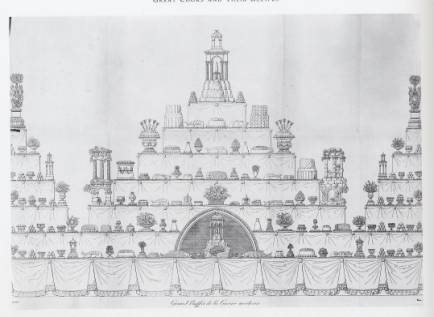
P.S. To any readers whose French is better than mine, I'd love to know if Le Monde, etc. refer to corner, penalty, free kicks as "piéces montees."
I suppose it's a fine phrase, but those familiar with gastronomic history know that "set pieces" are actually the English translation of the French "piéces montees." Piéces montees were elaborate confections created by pastry chefs to rest in the middle of medieval and early modern feasts. They were inedible and often included moving parts, firecrackers, and live animals. See the lovely movie Vatel for recreations. So now, everytime I listen to soccer I imagine myself carried back to a world of non-stop feasting. It's especially bad when I'm watching Les Bleus.

P.S. To any readers whose French is better than mine, I'd love to know if Le Monde, etc. refer to corner, penalty, free kicks as "piéces montees."
Wednesday, June 07, 2006
Neckenmarkt Blaufrankisch Classic Burgenland 2004
Last night we made the mistake of roasting a chicken. Normally it wouldn't be a problem, but we have yet to install our air conditioners for the season, and our oven is incredibly inefficient. After an hour of cooking, the kitchen had reached 100 degrees. To accompany the bird, I made le Puy lentils and Stephanie prepared a salad with a bacon dijon vinaigrette, topping mine with a pair of poached quail eggs.
She chose this Austrian red to wash everything down. This is our second Austrian red in a couple of weeks, and I must admit to being quite pleased with the quality of the wines. Perfectly ripe and round, this wine showed a bouquet of floral and fruity aromas and flavors. It lacked the tannins and acidity to be particularly deep or profound, but despite this lack of structure, it was restrained and drinkable. While it went fine with the chicken, I'd prefer it as a sipping wine for cocktail parties and such. And with an $11 price tag, one could easily buy enough for a crowd.
She chose this Austrian red to wash everything down. This is our second Austrian red in a couple of weeks, and I must admit to being quite pleased with the quality of the wines. Perfectly ripe and round, this wine showed a bouquet of floral and fruity aromas and flavors. It lacked the tannins and acidity to be particularly deep or profound, but despite this lack of structure, it was restrained and drinkable. While it went fine with the chicken, I'd prefer it as a sipping wine for cocktail parties and such. And with an $11 price tag, one could easily buy enough for a crowd.
Friday, June 02, 2006
Mas de Boislauzon Chateauneuf-du-Pape 2001
Due to recent travels, Stephanie and I have been away from the kitchen for the past couple of weeks. We resumed our normal culinary routine last night when I grilled skirt steak roulades stuffed with carmelized shallots and chevre. Stephanie prepared polenta and assembled a green salad.
The local wine store was running a sale on some of its Chateauneuf's, so I picked up this bottle for only $20 (the average for CdP is between $30 and $70). Unfortunately, it seems, you get what you pay for. I should have been clued in by the unusual stamp on the bottle. Normally, CdP bottles portray the papal seal stamped in glass above the label.

This bottle, however, had only a representation of the pontiff's hat.

At five years old, it had lost much of its fruit character, but the earthly flavors that come with maturity had not yet made an appearance. The wine was rather too dry, with a somewhat chalky finish that eventually improved to taste of earl grey tea. For the money, I'd recommend buying a high-quality Gigondas or even one of the excellent Cotes-du-Rhone from Domaine les Aphillantes.
Wednesday, May 31, 2006
Le Bernardin
I had my first experience with New York City haute cuisine this past weekend when John, another friend of this blog, joined me for lunch at Le Bernardin (his favorite restaurant -- and he is not alone). Bernardin specializes in seafood -- it's almost considered a crime to order anything else -- and we largely stuck to the theme. For my first course, I ordered a dish of raw wild salmon marinated in olive oil, lemon, and grapefruit juice, which I found exquisite and briskly refreshing. If anything, the tangy marinade slightly overwhelmed the taste of the salmon and could have been toned down slightly, but this was a very small concern -- the dish was terrific. John had layers of thinly pounded raw yellowfin tuna arrayed over thinly spread foie gras, and the rich taste of the tuna coupled with the even richer foie gras was a fabulous combination. These are not tastes that one is used to experiencing together, but they worked marvelously.
My main course was broiled scallops in a Bouillabaisse with clams, mussels, and vegetables. The scallops were done perfectly -- tender and delicious, and not overly "fishy" as lesser-quality scallops can tend to be -- and were complemented wonderfully by the excellent (though unspectacular) Bouillabaisse. John opted to order two additional first courses in lieu of a main course, and chose a sea urchin (uni) custard, served warm, and a foie gras terrine. (As readers of this blog are undoubtedly aware, foie gras will soon be illegal in the city of Chicago, and so native Chicagoans such as John are doing their best to consume as much as possible before then.) These two dishes were almost heart-stoppingly rich, and utterly fantastic. Probably like many other sushi eaters I'm used to uni being served cold, so the warm custard was an interesting and effective variation. The foie gras, not surprisingly, was decadent enough to die for, and -- if one were to consume enough -- that would probably be the outcome.
For dessert I ordered a chocolate-cashew tart accompanied by various sauces and reductions (caramel, banana, red wine) that was perhaps even more amazing than anything I had eaten to that point. The tart was extremely delicate and yet, needless to say, very rich, and not overly sweet. In fact, it so overwhelmed my taste buds (and my memory) that I have essentially no recollection of what John ordered, despite the fact that I tasted it. We also each ordered a glass of Chardonnay that was quite good but the name of which, unfortunately, I also cannot remember.
The food at Le Bernardin was, on the whole, magnificent, but the service also bears serious mention. Le Bernardin's service is the best that I have ever experienced, though not in the typical manner that one might expect. It wasn't "spectacular" or "flashy" in any sense; there wasn't any coordinated motion or trickery or flamboyant presentation. It was just perfectly timed and refreshingly informal; the waiters seemed relaxed and appeared to be enjoying themselves, the restaurant was accommodating of unorthodox requests (such as John's three first courses), and no one there seemed hung up on what a wonderful restaurant it was. I even appreciated the fact that the waiters (all of whom were genuinely French) wrote our orders down in small notebooks. There was no need to impress us with their incredible memories; they just wanted to get the orders right and deliver them promptly. And needless to say, whenever my water glass neared the point of being empty someone would magically appear and fill it, and whenever I had picked up the last remaining morsel of bread someone would arrive and offer me another piece. In typical French fashion, Le Bernardin also did not bring us the check until we asked for it, a nice change from typically time-crunched American dining. Le Bernardin's reputation as one of the best restaurants in New York is, in my opinion, well-deserved, and at the extremely reasonable price of $51 for a three-course lunch it was very much worth the trip.
Thursday, May 18, 2006
Tijou Savennieres Clos des Perrieres 2000
Yesterday we enjoyed one of our best, an easiest, homemade dinners in a long time. We had a frisee salad which Stephanie dressed with a vinaigrette of dijon mustard, sherry vinegar, and rendered bacon fat, topped with slab bacon and poached quail eggs. It was sublime. I grilled a whole golden trout that turned out to be the best fish I have made in ages. The flesh was a beautiful golden color, lighter than salmon but darker, and richer, than the standard rainbow trout. It was grilled simply, with only salt and pepper and a sprig of rosemary in the cavity.
Sadly the wine I chose to accompany the meal didn't show as well. 2000 was a tough vintage for France's Loire valley, and five years of bottle age did nothing to improve this bottle of chenin blanc. Regular blog readers will know that I have been fascinated with chenin (and chenin taste-alikes like falanghina) lately, but this bottling had neither the racy acidity nor round melon and stone-fruit flavors that make Savennieres my go-to wine. I'd love to try it in a better vintage.
Sadly the wine I chose to accompany the meal didn't show as well. 2000 was a tough vintage for France's Loire valley, and five years of bottle age did nothing to improve this bottle of chenin blanc. Regular blog readers will know that I have been fascinated with chenin (and chenin taste-alikes like falanghina) lately, but this bottling had neither the racy acidity nor round melon and stone-fruit flavors that make Savennieres my go-to wine. I'd love to try it in a better vintage.
Thursday, May 11, 2006
Caves Cidis Gamaret La Cote 2003 (Switzerland)
We celebrated the acceptance of our offer on a new house last night with a roasted pheasant in natural jus. It was accompanied by a saute of spring vegetables - Trumpet royale mushrooms, ramps, fiddlehead ferns, and favas. I should have a picture up soon.
The pheasant seemed like a fine time to try out a Swiss red wine that I had picked up recently. The grape varietal was Gamaret, which the label claims is a hybrid Gamay grape, most famously from Beaujolais, and an indigenous grape called Reichensteiner. The wine had a surprisingly dark color and full body - certainly more so than a standard Beaujolais cru wine. It did have the anticipated red fruit, especially cherry, notes and some oak. The finish was rather short for the slightly gamy pheasant, but it would have been just fine with chicken or pasta. Like its half-brothers from Beaujolais, it certainly improves when served at a slightly lower temperature.
Time to get back to French wines now.
Tuesday, May 09, 2006
Markowitsch Carnuntum Cuvee 2003 - An Austrian Red
Although it's Spring here in Chicago, in the Southern Hemisphere autumn is arriving, and thanks to worldwide food distribution, we were able to enjoy some delicious grilled venison chops last night. Stephanie sauteed some dandelion greens, and I glazed some yellow carrots. The venison was perfect, and I hope the grocery stores make an effort to keep it in stock. It's a pleasant respite from the endless cycle of chicken, beef, lamb, pork, and fish.
I got a little daring at the wine shop this weekend and broke from my usual francophilia. I chose a pair of reds from Austria, the first of which we drank with the venison. Although I didn't know it, Markowitsch is one of the country's top producers, and their reputation seemed well-earned after tasting their entry-level Carnuntum Cuvee. It's a blend of 80% zweigelt, an indigenous varietal, and 20% pinot noir. Surprisingly full-bodied, the wine displayed inviting red fruit flavors and hinted at that citrusy note one occassionally finds in the Southern Rhone. Not overly tannic, it paired supremely well with the meaty yet lean venison, and it would prove a welcome companion for good pork, beef stew, and especially, duck. At $12, it's worth buying a case, and it encouraged me to seek out their better bottlings.
I got a little daring at the wine shop this weekend and broke from my usual francophilia. I chose a pair of reds from Austria, the first of which we drank with the venison. Although I didn't know it, Markowitsch is one of the country's top producers, and their reputation seemed well-earned after tasting their entry-level Carnuntum Cuvee. It's a blend of 80% zweigelt, an indigenous varietal, and 20% pinot noir. Surprisingly full-bodied, the wine displayed inviting red fruit flavors and hinted at that citrusy note one occassionally finds in the Southern Rhone. Not overly tannic, it paired supremely well with the meaty yet lean venison, and it would prove a welcome companion for good pork, beef stew, and especially, duck. At $12, it's worth buying a case, and it encouraged me to seek out their better bottlings.
Subscribe to:
Posts (Atom)
