I know I owe the world an entry on our wonderful Easter-versary brunch at Spiaggia, and it's on the way, but I wanted to briefly mention a couple of interesting items on law and food. My university is particularly involved in these issues, and I thought it would be nice to bring them to your attention.
First is a column by William Saletan on "The War on Fast Food," where he predicts the development of a crusade against the fast food industry. Saul Levmore, the dean of the UofC law school, has been blogging on this topic recently, and both are worth reading.
Also on the Chicago Law Faculty Blog, Jeff Leslie and Cass Sunstein have been posting on animal welfare regulation. In short, they propose the adoption of labeling standards indicating the level of animal cruelty involved in the production of meat for food. As with Free-Trade coffee and free-range chickens, consumers can make their preferences felt through their buying habits since the treatment of the animals involved would be more salient. It's an interesting proposal, but it seems to raise some of the same concerns that I have written about regarding the moral indignation accompanying "organicism," i.e. the potential for poor people who chose to purchase the presumably cheaper meat from cruelly treated animals to be viewed with disdain and disgust by those capable of paying the cruelty-free premiums. Such people will be forced to choose between providing for their families or following their moral disinclination to eat meat from cruelly treated animals.
Wednesday, April 19, 2006


Wednesday, April 12, 2006
Ch. Duhart-Milon 2003, Ch. d'Armailhac 2003, and Ch. d'Issan 2003
Sadly today marks the end of our Bordeaux 2003 tasting. Of course, we'll be sampling many more in the future (at least if we don't buy a house), but this will have been our most systematic endeavour. We finished with a meal of grilled Italian sausage with peppers and onions and a side of Stephanie's indescribably delicious cole slaw.
The Duhart-Milon was the first of two wines from the Paulliac region on Bordeaux's left bank, home of some of Bordeaux's greatest chateaux (Latour, Mouton Rothschild, and Lafitte Rothschild - the last of which is responsible for this wine). It was a pleasure to drink, with bold fruit and very fine tannins. The mid-palate was expansive, spreading through the mouth softly but with a purpose. It gave off a hint of alcohol (not surprising from such a warm vintage), but it only served to highlight the character of the fruit and wood. I only wonder if a wine as supple as this will fair well over the long haul.
Chateau d'Armailhac is associated with the other great family of Bordeaux Rothschilds, the Moutons. Like the Duhart-Milon, it is not a second wine of the "grand vin" but rather an independent estate bottled under the auspices of its more famous uncle. Oak and dark fruit predominate on the nose, with a candied cherry burst through the mid-palate. The tannins here are firmer, but the finish in decidedly shorter.
The Chateau d'Issan is a delightful wine with an unfortunate label. Although a 3rd Growth in the 1855 classification, this chateau was not performing well in the wine press. The 03 is, as I said, delightful, and as the only Margaux in the tasting, it proved an excellent representative of its appellation. Soft in texture and fruit, the wine was silky on the palate with round raspberry and dark cherry notes. Stephanie compared the aroma to the ocean. Tasted blind I would have thought that it came from one of the predominantly merlot growing regions like St. Emilion or Pomerol.
After a week of new vintage Bordeaux, I think it's time to drink some light white wines and hope my tooth enamel will regrow.
The Duhart-Milon was the first of two wines from the Paulliac region on Bordeaux's left bank, home of some of Bordeaux's greatest chateaux (Latour, Mouton Rothschild, and Lafitte Rothschild - the last of which is responsible for this wine). It was a pleasure to drink, with bold fruit and very fine tannins. The mid-palate was expansive, spreading through the mouth softly but with a purpose. It gave off a hint of alcohol (not surprising from such a warm vintage), but it only served to highlight the character of the fruit and wood. I only wonder if a wine as supple as this will fair well over the long haul.
Chateau d'Armailhac is associated with the other great family of Bordeaux Rothschilds, the Moutons. Like the Duhart-Milon, it is not a second wine of the "grand vin" but rather an independent estate bottled under the auspices of its more famous uncle. Oak and dark fruit predominate on the nose, with a candied cherry burst through the mid-palate. The tannins here are firmer, but the finish in decidedly shorter.
The Chateau d'Issan is a delightful wine with an unfortunate label. Although a 3rd Growth in the 1855 classification, this chateau was not performing well in the wine press. The 03 is, as I said, delightful, and as the only Margaux in the tasting, it proved an excellent representative of its appellation. Soft in texture and fruit, the wine was silky on the palate with round raspberry and dark cherry notes. Stephanie compared the aroma to the ocean. Tasted blind I would have thought that it came from one of the predominantly merlot growing regions like St. Emilion or Pomerol.
After a week of new vintage Bordeaux, I think it's time to drink some light white wines and hope my tooth enamel will regrow.
Ch. Smith Haut Lafitte 2002 and 2003
We broke from the strict Bordeaux 2003 trend last night to compare the 2002 and 2003 vintages of Chateau Smith Haut Lafitte's red wine from the Pessac-Leognan appellation. I recently tasted the 1995 and found it a little lacking in stuffing, but the newest vintages were firmer and rounder. Known as a graceful wine, neither overwhelmed with fruit, earth, or tannin. Not surprisingly, the wines were very similar with complex fruits and spices combined with a long, tight finish. The most notable difference was in the mid-palate, where the 2003 flowed over the tongue while the 2002 barely paused. This difference made the 03 feel fuller and more coherent from the front to the back of the mouth. While the 2003 was certianly better, the difference will only be meaningful for most drinkers (myself included) in the long term. Over the next few years, those looking for a ready to drink Bordeaux would be advised to purchase the much cheaper 2002.
Monday, April 10, 2006
Ch. Sociando Mallet 2003 & Ch. d'Aiguilhe 2003
Our 2003 Bordeaux tasting continued tonight alongside grilled Praire Grove Farm pork tenderloin, white rice, and delicious braised kale. To match, I chose the two wines with the highest percentages of merlot in their blends, the Sociando-Mallet from the Haut Medoc region on Bordeaux's left bank and the d'Aiguilhe from the promising Cotes de Castillon appelation on the right bank.
Sociando-Mallet has been a favorite of mine for a while. It's status as a "cru bourgeois" wine means that its price remains low, but the its quality is simply superb. This vintage is classically structured, with a deep, oaky aroma matched by complex earth and spice notes on the palate. The tannins are substantial, but they don't prohibit enjoying the wine even in its infancy. In fact, its mature profile would suggest that the wine is at least a decade old already. I consider this a benefit. Unmistakably bordeaux.
The d'Aiguilhe is owned by the impeccably dressed Count Stephan von Niepperg, who also owns Canon Gaffeliere and La Mondotte in the St. Emilion region of Bordeaux. The beverage sub judice is his version of "slumming it," as he ventures into the much less fashioable Cotes de Castillon region. Predominantly merlot, this wine is modern in style with soft curves and ripe fruit. Regular readers will assume that such a description amounts to a death sentence on this blog, but the d'Aiguilhe is an exception. Whatever it lacks in tannin and acidic structure it more than makes up for in complex fruit aroma and flavor. Rarely have I tasted a wine with such a deep and sophisticated fruit profile, such that a mere listing of the detected scents would only diminish the wine's appeal. Although perhaps not classic bordeaux, the world would be a better place if American and Australian merlot vintners would make wine like this.
Tomorrow we'll taste either a pair of Pauillacs or an 02 vs. 03 showdown of Smith Haut Lafitte. Tell your friends.
Sociando-Mallet has been a favorite of mine for a while. It's status as a "cru bourgeois" wine means that its price remains low, but the its quality is simply superb. This vintage is classically structured, with a deep, oaky aroma matched by complex earth and spice notes on the palate. The tannins are substantial, but they don't prohibit enjoying the wine even in its infancy. In fact, its mature profile would suggest that the wine is at least a decade old already. I consider this a benefit. Unmistakably bordeaux.
The d'Aiguilhe is owned by the impeccably dressed Count Stephan von Niepperg, who also owns Canon Gaffeliere and La Mondotte in the St. Emilion region of Bordeaux. The beverage sub judice is his version of "slumming it," as he ventures into the much less fashioable Cotes de Castillon region. Predominantly merlot, this wine is modern in style with soft curves and ripe fruit. Regular readers will assume that such a description amounts to a death sentence on this blog, but the d'Aiguilhe is an exception. Whatever it lacks in tannin and acidic structure it more than makes up for in complex fruit aroma and flavor. Rarely have I tasted a wine with such a deep and sophisticated fruit profile, such that a mere listing of the detected scents would only diminish the wine's appeal. Although perhaps not classic bordeaux, the world would be a better place if American and Australian merlot vintners would make wine like this.
Tomorrow we'll taste either a pair of Pauillacs or an 02 vs. 03 showdown of Smith Haut Lafitte. Tell your friends.
Sunday, April 09, 2006
Ch. Branaire-Ducru and Ch. Lagrange 2003
I was fortunate enough to stumble upon a hefty stash of 2003 Bordeaux half bottles at the local wine shop, so we'll be offering some notes on them for the next few days. According to most authorities, 2003 promises to be one of Bordeaux's better vintages (although it seems like they are saying this more and more lately). The weather in France was incredibly hot, so most of the wines are ripe and well-extracted.
Both of these wines come from the St. Julien appelation on Bordeaux's left bank. This means that they are composed of primarily Cabernet Sauvignon with additions of Merlot, Cabernet France, and possibly Malbec and Petit Verdot. The Branaire-Ducru was exuberant and fleshy, with a smoky, toasty nose and a round mouthfeel. The tannins are firm, but reasonably well integrated with the fruit and acid. I found it a bit overdone at this stage in its life, but I suspect that the oak will mellow nicely, producing a rich, complex wine in a decade or so.
Chateau Lagrange is an up-and-coming estate, whose 2000 wine was very well received in the wine press. It too had a smoky aroma that I found a bit sweeter and baconier than the Branaire. The heat from the vintage shows in the significantly alcoholic aroma that detracts from the wine's overall impression. We both found it more fruity than the Branaire but offering less character, complexity, and substance.
Look forward to notes on the Smith Haut Lafitte, Duhart-Milon, and others in the next few days.
Both of these wines come from the St. Julien appelation on Bordeaux's left bank. This means that they are composed of primarily Cabernet Sauvignon with additions of Merlot, Cabernet France, and possibly Malbec and Petit Verdot. The Branaire-Ducru was exuberant and fleshy, with a smoky, toasty nose and a round mouthfeel. The tannins are firm, but reasonably well integrated with the fruit and acid. I found it a bit overdone at this stage in its life, but I suspect that the oak will mellow nicely, producing a rich, complex wine in a decade or so.
Chateau Lagrange is an up-and-coming estate, whose 2000 wine was very well received in the wine press. It too had a smoky aroma that I found a bit sweeter and baconier than the Branaire. The heat from the vintage shows in the significantly alcoholic aroma that detracts from the wine's overall impression. We both found it more fruity than the Branaire but offering less character, complexity, and substance.
Look forward to notes on the Smith Haut Lafitte, Duhart-Milon, and others in the next few days.
Saturday, April 08, 2006
Fayolle Crozes-Hermitage Les Pontaix 1998
Stephanie had a particularly awesome day at court yesterday (and a dreadful salad for lunch), so I decided to grill up a nice piece of beef and pair it with an older wine. I grilled a bone-in ribeye and served it with Stephanie's carmelized onions and a red wine sauce. We had roasted red potatoes and roasted yellow and red belgian endive with chevre. Everything was fabulous, and it matched well with a seven year old wine from France's northern Rhone valley.
Crozes-Hermitage is one of the "lesser" regions of the northern Rhone, but it's wines are excellent values, and in good vintages, they can stand a bit of bottle age. Presumably 100% syrah, this bottle showed excellent mature flavors and aromas of earth and dried fruit. It really came around after being open for a while, and it's medium-full body and refined tannins played well off the steak. Although most people won't be able to find this one still on the shelves, Chicago readers can locate it at the House of Glunz on Wells Street.
Crozes-Hermitage is one of the "lesser" regions of the northern Rhone, but it's wines are excellent values, and in good vintages, they can stand a bit of bottle age. Presumably 100% syrah, this bottle showed excellent mature flavors and aromas of earth and dried fruit. It really came around after being open for a while, and it's medium-full body and refined tannins played well off the steak. Although most people won't be able to find this one still on the shelves, Chicago readers can locate it at the House of Glunz on Wells Street.
Thursday, April 06, 2006
Beaujolais Tasting
Stephanie and I enjoyed a roast chicken dinner last night with scallion and sour cream mashed potatoes and individual terrines of creamed spinach. I had been saving a couple of half bottles of beaujolais for such a dinner. The wines, from the 2001 vintage, were produced by Alfred Gino Bertolla at Domaine du Granit, and they both come from the smaller appellation, or "cru", of Moulin-a-Vent. Although most Americans are familiar with beaujolais only for its mass-marketed, quickly made "nouveau" released in the Fall, this region on the south side of Burgundy produces a number of excellent wines that are capable of significant aging. And they all cost less than $20. Interestingly, as a marketing ploy, whomever labeled these bottles called them "Red Burgundy Wine," eschewing the association with beaujolais all together. Like all beaujolais wines, however, these were made from the gamay grape, rather than burgundy's pinot noir.
The only difference between the two wine labels is that one reads "La Rochelle" and the other "Les Caves." I initially thought these represented different vineyards, but now I believe they are just different winemaking styles. The La Rochelle was a fairly classic beaujolais - red cherries, with a touch of sourness, some oak but fairly restrained, and of medium body and extraction. Its sister, the Les Caves, was far more modern, with a rich aroma of spicy, smoky oak and a broader and riper fruit profile. It bordered on Aussie shiraz. Regular readers of this blog will of course anticipate that I preferred the former, as it matched my expectations and complemented the food better.
The only difference between the two wine labels is that one reads "La Rochelle" and the other "Les Caves." I initially thought these represented different vineyards, but now I believe they are just different winemaking styles. The La Rochelle was a fairly classic beaujolais - red cherries, with a touch of sourness, some oak but fairly restrained, and of medium body and extraction. Its sister, the Les Caves, was far more modern, with a rich aroma of spicy, smoky oak and a broader and riper fruit profile. It bordered on Aussie shiraz. Regular readers of this blog will of course anticipate that I preferred the former, as it matched my expectations and complemented the food better.
Monday, April 03, 2006
Food and Society Conference
I'm excited to announce that I have been invited to present a paper at the annual conference of the Association for the Study of Food and Society. The conference is meeting in Boston, on June 7-11. I will be presenting my work on the copyrightability of recipes currently titled "On the Legal Consequences of Sauces: Should Thomas Keller's Recipes be Per Se Copyrightable?" The first part of the title is derived from Lancelot Sturgeon's 19th century "stomachical" essays, and the last part is a lame play on the name of Keller's NYC restaurant. Check out the society's website. They have lots of interesting information.
Fiddleheads and Ramps!!!
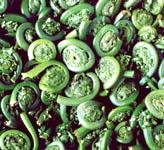
Spring is in the air - well, at least it was last Thursday - and you know what that means - FIDDLEHEAD FERNS!!! The world's greatest vegetable begins its incredibly short growing season in a few weeks, so now is the time to place your order. Stephanie and I first tasted these wonderful delights at Hugh Acheson's Five & Ten restaurant in Athens, Ga a few years ago, and we have been ordering them from Earthy Delights ever since (www.earthydelights.com). They're not cheap, but they're absolutely worth it.
Fiddleheads are the shoots of the ostrich fern. They are harvested a couple weeks after breaking through the soil when the plant is curled back on itself like the head of a violin. Their flavor is deep and earthy, and they are best quickly sauteed in olive oil with a bit of lemon. Or you can do like we do and order three or four pounds of them and try to invent new combinations. They're only around for about a month, so don't miss out.
And while you're at it, buy a pound of ramps, i.e. baby leeks, for grilling or pickling.
A Visit from Sir Jeffington
Stephanie and I welcomed a visit from her cousin Jeff this weekend. He stopped off in Chicago for a few days on a cross-country (car) trip to Montana after graduating from medical school. Stephanie had to work, so I had the pleasure of showing Jeff around Chicago's many gastronomic hotspots. He arrived late Wednesday evening and was greeting with grilled Praire Groves Farm pork tenderloin and a bottle of Vino Nobile. The pork was the most tender I have eaten at home. Although twice the price of the grocery store brand, the added flavor was worth it.
Thursday began with a carbo load of bagels before a bike ride to the Loop to meet Stephanie for lunch at PotBelly sandwich shop. Jeff and I then toured Millennium Park and stopped off at Up Down Tobacco for some pipe tobacco and a gorgeous 100th Anniversary Davidoff cigar. I smoked the Davindoff last night with some Lagavulin 16, and it was divine.
But back to our trip. From Up Down we rode to the Goose Island Brewery. Jeff is a beer aficionado and wanted to sample the local suds. Everything was solid, but the highlight had to be the Barleywine brewed to celebrate their 2000th batch. It was excellent with a platter of sausages. We wobbled across the street to Sam's (the wine shop not the big-box store, although you'd never know from the size of the buildings) to admire the beer selection. We chose some unusual bottles to sample at home and I got into a heated debate about Trappist ales with the beer specialist (it turns out we were both right but I was more right than he was). After a wobbly bike ride home, we settled in for some Chicago-style pizza and a fabulous bottle of Rodenbach Grand Cru. There was some risk of this Flemish brewery going out of business, but they seem to be doing well. Michael Jackson, the beer writer not the pop star, once called this sour red ale the most refreshing beer in the world, and he couldn't be more right. What a treat!
Friday also began with bagels, but our butts hurt too much to try to ride bikes again. We drove to lunch at the infamous Hot Doug's (previously mentioned on these pages). Jeff had his first Chicago-style dog, and we added a smoked pheasant sausage, a ribeye sausage with roasted garlic cloves, and an unbelievably delicious toulouse sausage with saffron rouille. Jeff was sure getting his fill of encased meats. That night Stephanie made reservations at the Green Dolphin Street jazz club. Dinner was fairly good - grilled meats with a la carte sides - but a bit overpriced. The free admission to club softened this blow, however. The wine list was very strong in American reds, and there were even a few unusual deals. The music was superb and tremendously entertaining, as was the Ardbeg 10 I drank while enjoying it.
On Saturday we met some friends for a late breakfast at Lou Mitchell's, a Chicago landmark diner. The sausages and bacon were some of the best I have eaten, but this may have been due to the free doughnut holes they used to quicken our appetites. We then went to a vintage poster show ostensibly sponsored by Wine Spectator. Although the posters were amazing, WS had no perceivable presence. That was the only disappointment in an otherwise fascinating exhibit. By mid afternoon we were running out of steam, so we lounged around the house watching the rather boring basketball. Appetites were again whetted, however, by a couple dozen kumomoto oyster and bottles of stout. Stephanie insisted that we keep dinner light, so I made linguine with mussels washed down with a bottle of dry Aussie riesling. Very satisfying.
Jeff visit was a great pleasure. I was glad to introduce him to some of Chicago's best culinary offerings - mostly charcuterie and alcohol - and I was glad that he reacquainted me with pipe smoking. I purchased a new one, and I look forward to learning to smoke it.
Thursday began with a carbo load of bagels before a bike ride to the Loop to meet Stephanie for lunch at PotBelly sandwich shop. Jeff and I then toured Millennium Park and stopped off at Up Down Tobacco for some pipe tobacco and a gorgeous 100th Anniversary Davidoff cigar. I smoked the Davindoff last night with some Lagavulin 16, and it was divine.
But back to our trip. From Up Down we rode to the Goose Island Brewery. Jeff is a beer aficionado and wanted to sample the local suds. Everything was solid, but the highlight had to be the Barleywine brewed to celebrate their 2000th batch. It was excellent with a platter of sausages. We wobbled across the street to Sam's (the wine shop not the big-box store, although you'd never know from the size of the buildings) to admire the beer selection. We chose some unusual bottles to sample at home and I got into a heated debate about Trappist ales with the beer specialist (it turns out we were both right but I was more right than he was). After a wobbly bike ride home, we settled in for some Chicago-style pizza and a fabulous bottle of Rodenbach Grand Cru. There was some risk of this Flemish brewery going out of business, but they seem to be doing well. Michael Jackson, the beer writer not the pop star, once called this sour red ale the most refreshing beer in the world, and he couldn't be more right. What a treat!
Friday also began with bagels, but our butts hurt too much to try to ride bikes again. We drove to lunch at the infamous Hot Doug's (previously mentioned on these pages). Jeff had his first Chicago-style dog, and we added a smoked pheasant sausage, a ribeye sausage with roasted garlic cloves, and an unbelievably delicious toulouse sausage with saffron rouille. Jeff was sure getting his fill of encased meats. That night Stephanie made reservations at the Green Dolphin Street jazz club. Dinner was fairly good - grilled meats with a la carte sides - but a bit overpriced. The free admission to club softened this blow, however. The wine list was very strong in American reds, and there were even a few unusual deals. The music was superb and tremendously entertaining, as was the Ardbeg 10 I drank while enjoying it.
On Saturday we met some friends for a late breakfast at Lou Mitchell's, a Chicago landmark diner. The sausages and bacon were some of the best I have eaten, but this may have been due to the free doughnut holes they used to quicken our appetites. We then went to a vintage poster show ostensibly sponsored by Wine Spectator. Although the posters were amazing, WS had no perceivable presence. That was the only disappointment in an otherwise fascinating exhibit. By mid afternoon we were running out of steam, so we lounged around the house watching the rather boring basketball. Appetites were again whetted, however, by a couple dozen kumomoto oyster and bottles of stout. Stephanie insisted that we keep dinner light, so I made linguine with mussels washed down with a bottle of dry Aussie riesling. Very satisfying.
Jeff visit was a great pleasure. I was glad to introduce him to some of Chicago's best culinary offerings - mostly charcuterie and alcohol - and I was glad that he reacquainted me with pipe smoking. I purchased a new one, and I look forward to learning to smoke it.
Thursday, February 16, 2006
Valentine's Day Lunch and Dinner
Stephanie and I celebrated Valentine's Day fairly quietly although very deliciously. She made reservations for us to have lunch at one of my favorite restaurants - Blackbird (see earlier post). The food there is always so satisfying, so mouth-watering to type about. Stephanie began with a spicy salmon tartare with avocado and homemade saltine. Then she had her favorite pork belly sandwich with b&b pickles. It's so good. After taking a bite, you don't even want to wipe your mouth for all the delicious flavor still on your lips. I began with the confit of suckling pig, a dish I've been looking forward to trying. My main course was a phenomenal bouillabaisse. Everything was perfect.
That evening for dinner I prepared a Valentine's themed meal. The first course was cream of tomato soup with pink shrimp served with Bellefon Cuvée des Moines Brut Rosé Champagne NV. Next was veal involtini with mushrooms in a pink peppercorn rosé sauce and mashed pink-skinned potatoes. It was accompanied by a bottle of Domaine du Joncier Lirac Rosé 2004. Dessert was a simple pink grapefruit granite. Everything turned out very well, and Stephanie seemed to enjoy it. I can't wait until my green St. Patrick's Day meal (don't worry, there won't be very many vegetables).
That evening for dinner I prepared a Valentine's themed meal. The first course was cream of tomato soup with pink shrimp served with Bellefon Cuvée des Moines Brut Rosé Champagne NV. Next was veal involtini with mushrooms in a pink peppercorn rosé sauce and mashed pink-skinned potatoes. It was accompanied by a bottle of Domaine du Joncier Lirac Rosé 2004. Dessert was a simple pink grapefruit granite. Everything turned out very well, and Stephanie seemed to enjoy it. I can't wait until my green St. Patrick's Day meal (don't worry, there won't be very many vegetables).
Thursday, January 26, 2006
My Visit With Charlie Trotter
As some readers of this blog know, I am currently working on a law review article examining the copyrightability of recipes in American law. I decided that it would be useful to interview master chefs to discuss their thoughts on originality, creativity, recipes, and the Western culinary tradition to better understand how recipes function for people at the top of their profession (one might, of course, say "art"). Last week I called up Charlie Trotter's and left the chef a voicemail telling him of my project and requesting a time for an interview. He returned my call on Monday, proposing that we meet on Wednesday. I immediately accepted.
I arrived at the restaurant about fifteen minutes early and was greeted by someone on the staff. Charlie would be right out, I was told, and I was given a seat in the studio where they film Kitchen Sessions with Charlie Trotter. The chef appeared in a few minutes, and we removed to the bar. He was a very pleasant and friendly gentleman, and he answered my questions for over half an hour. Chef Trotter likens cooking to jazz music, and he had plenty of insight into my subject matter.
After thirty minutes or so, the chef recommended that we move the site of the interview, saying that "we don't want this to be just an ordinary interview." Barely able to control my excitement, I was led into the kitchen and was seated at a table set for one. I was introduced to chef de cuisine Mathias Merges who sat down with me and answered more of my questions for another hour and a half. During this time I was served an elaborate five-course lunch with expertly paired wines.
Lunch began with a duo of olive oil poached salmon with smoked salmon roe and monkfish liver served with eel terrine. It was marvelous. The smoked roe seemed inspired by my favorite Scottish whiskies, and the monkfish live and eel expertly combined sweet and bitter components. The next course was buttermilk poached poulard breast with pomegranate gastrique paired with a delightful sauvi blanc from Justin Winery. This was followed by turbot and kumomoto oyster with watermelon radish and grapefruit served with sake. The meat course was a gorgeous preparation of roasted squab with black trumpet mushrooms, oxtail, collard greens, and braised carrots. It was paired with Brooks Pinot Noir 2004. Finally, I was presented with a light and refreshing dessert of fuji apples with butterscotch and rye crisp matched with Isole e Olena's Vin Santo 1998.
Everything was beyond my wildest expectations. Chefs Trotter and Merges were incredibly gracious with their time and their patience answering all of my inartfully worded questions. While I ate, members of the staff wandered by and introduced themselves to me, sharing insights about food, wine, recipes, and cooking. All of their ideas will certainly appear in my finished paper. I was very lucky to have this opportunity, and I am very grateful to everyone at the restaurant.
I arrived at the restaurant about fifteen minutes early and was greeted by someone on the staff. Charlie would be right out, I was told, and I was given a seat in the studio where they film Kitchen Sessions with Charlie Trotter. The chef appeared in a few minutes, and we removed to the bar. He was a very pleasant and friendly gentleman, and he answered my questions for over half an hour. Chef Trotter likens cooking to jazz music, and he had plenty of insight into my subject matter.
After thirty minutes or so, the chef recommended that we move the site of the interview, saying that "we don't want this to be just an ordinary interview." Barely able to control my excitement, I was led into the kitchen and was seated at a table set for one. I was introduced to chef de cuisine Mathias Merges who sat down with me and answered more of my questions for another hour and a half. During this time I was served an elaborate five-course lunch with expertly paired wines.
Lunch began with a duo of olive oil poached salmon with smoked salmon roe and monkfish liver served with eel terrine. It was marvelous. The smoked roe seemed inspired by my favorite Scottish whiskies, and the monkfish live and eel expertly combined sweet and bitter components. The next course was buttermilk poached poulard breast with pomegranate gastrique paired with a delightful sauvi blanc from Justin Winery. This was followed by turbot and kumomoto oyster with watermelon radish and grapefruit served with sake. The meat course was a gorgeous preparation of roasted squab with black trumpet mushrooms, oxtail, collard greens, and braised carrots. It was paired with Brooks Pinot Noir 2004. Finally, I was presented with a light and refreshing dessert of fuji apples with butterscotch and rye crisp matched with Isole e Olena's Vin Santo 1998.
Everything was beyond my wildest expectations. Chefs Trotter and Merges were incredibly gracious with their time and their patience answering all of my inartfully worded questions. While I ate, members of the staff wandered by and introduced themselves to me, sharing insights about food, wine, recipes, and cooking. All of their ideas will certainly appear in my finished paper. I was very lucky to have this opportunity, and I am very grateful to everyone at the restaurant.
La Chablisienne Chablis Premier Cru Mont de Milieu 2002
One of our local wine shops had a sale on French wines last weekend, and we picked up a few bottles of this Chablis to add to our cellar. Stephanie and I decided to prepare a nice Sunday dinner, however, and selected one of the bottles to accompany the meal. Stephanie began with a tasting of soups served in my new Valdrome demitasse cups. She prepared a subtle but interesting cauliflower soup and a deep and rich potato chowder with bacon and chives. The main course was one of my favorite dishes and one of the first I learned to cook - veal saltimbocca.
Chablis is the northern most region of Burgundy, and although it shares the same grape varietal with the wines of Montrachet, Corton-Charlemagne, and Mersault (i.e. Chardonnay), its wine tend to be leaner and more minerally. This wine, from one of Chablis's top producers, splendidly represented the style of the region. Stephanie and I both enjoyed the balance of crisp apple flavors with the chalk and slate textures on the finish. It displayed a truly expanisive mid-palate, where the fruity opening mingled with the acidic finish. Stephanie declared it among the best white wines she has had.
We were very pleased with the wine and it matched both the soups and the veal rather well. This bottle had a faulty cork that already displayed some leaking. It could certainly stand a decade or more of cellaring, but now we're anxious about the closures.
Chablis is the northern most region of Burgundy, and although it shares the same grape varietal with the wines of Montrachet, Corton-Charlemagne, and Mersault (i.e. Chardonnay), its wine tend to be leaner and more minerally. This wine, from one of Chablis's top producers, splendidly represented the style of the region. Stephanie and I both enjoyed the balance of crisp apple flavors with the chalk and slate textures on the finish. It displayed a truly expanisive mid-palate, where the fruity opening mingled with the acidic finish. Stephanie declared it among the best white wines she has had.
We were very pleased with the wine and it matched both the soups and the veal rather well. This bottle had a faulty cork that already displayed some leaking. It could certainly stand a decade or more of cellaring, but now we're anxious about the closures.
Tuesday, January 17, 2006
An MLK Weekend Not to Be Forgotten
Stephanie and I were pleased to welcome my great old friend Chuck and his wife Jayne to Chicago for a long weekend of eating, drinking, smoking, and general merriment. Chuck arrived late Friday night, and the festivities began immediately with a surprisingly delicious bottle of Marguet-Bonnerave Champagne Grand Cru NV. A rich and flavorful wine, the Bonnerave is an incredible bargain at $27 for grand cru champers (this means that the grapes come from vineyards that are specifically designated as producing high quality fruit every year). The bubbles, which were accompanied by our favorite toast, "Champagne for my real friends and real pain for my sham friends," were followed by the remainder of a bottle of Van Winkle Bourbon, a house favorite.
After a late start on Saturday, Stephanie, Chuck, and I made it out to Hot Doug's for some delicious frankfurters and duck fat fries. We picked Jayne up at two o'clock and enjoyed a long afternoon of wine shopping. For dinner we ordered deep dish pizza and polished off a bottle of Duval-Leroy NV bubbly, a corbieres, and a bourgogne rouge. After retiring to the basement lounge, Chuck presented me with an incredible birthday present - a bottle of Johnnie Walker Blue Label Scotch Whisky and a humidor full of Cuban cigars! That night we stayed up late imbibing the phenomenal Blue Label - peaty and full bodied, with a lingering caramel finish - and smoking the cubans. I had a sweet and round Cohiba Esplendito, while Chuck and Jayne shared a rustic and earthy Romeo y Julieta No. 2 that actually dated from at 2002 trip Montreal that Chuck and I took.
Not surprisingly, Sunday began in the late morning. At Jayne's suggestion we had a delightful brunch at the Atwood Cafe in the Loop and then took Lake Shore Drive down to Hyde Park for a tour of the university. We then made it back to the north side of town, and after a very stressful trip to Whole Foods, returned home to begin a home cooked feast. Dinner started with prawns sauteed in butter in my new cast iron skillet. They were served in a fresh pea soup with creme fraiche. Next, Stephanie prepared Rick Tramonto's amusing and scrumptious "linguine" and clams, where the linguine are actually julienned and blanched cucumbers served in the clam shell. These courses were enjoyed with the always fantastic Domaine de Baumard Savennieres 2002 (reviewed on this blog earlier). The main course was pan-roasted woodear mushroom crusted pork tenderloin, served on a ring of mashed potatoes with roasted shitake mushrooms and a red wine sauce. For this course, Chuck ("Big playa may big play in big game") had graciously purchased a bottle of the much-anticipated Chateau Beaucastel Chateauneuf du Pape 2001. This is certainly the most famous and widely appreciated wine from the region, and the '01 vintage proved why. A blend of Grenache, Syrah, Mouvedre, and a few other grapes, it showed great density and weight but absolutely pure flavors and a tremendous structure. It's often a bummer sharing wines like this with three other people, but I couldn't complain considering the depth of the conversation and incomparable balance of the company's wit and intelligence - not to mention their delightful aroma. That evening we again retired to the basement lounge for more Blue Label and habanas. This time I smoked a R&J Churchill, Chuck a Cohiba, and Jayne a Montecristo.
On Monday, Stephanie and I had to say goodbye to our weekend guests, but not, of course, before a fabulous lunch. Jayne and Chuck had been eyeing the Nine Steakhouse in Las Vegas and recommended that we visit the Chicago location. We ate splendidly although without vino, as we were all trying to rehydrate. Their visit was a wonderful success and a source of great personal joy (and decadence). We hope to soon join them in Vegas to try to outdo ourselves.
After a late start on Saturday, Stephanie, Chuck, and I made it out to Hot Doug's for some delicious frankfurters and duck fat fries. We picked Jayne up at two o'clock and enjoyed a long afternoon of wine shopping. For dinner we ordered deep dish pizza and polished off a bottle of Duval-Leroy NV bubbly, a corbieres, and a bourgogne rouge. After retiring to the basement lounge, Chuck presented me with an incredible birthday present - a bottle of Johnnie Walker Blue Label Scotch Whisky and a humidor full of Cuban cigars! That night we stayed up late imbibing the phenomenal Blue Label - peaty and full bodied, with a lingering caramel finish - and smoking the cubans. I had a sweet and round Cohiba Esplendito, while Chuck and Jayne shared a rustic and earthy Romeo y Julieta No. 2 that actually dated from at 2002 trip Montreal that Chuck and I took.
Not surprisingly, Sunday began in the late morning. At Jayne's suggestion we had a delightful brunch at the Atwood Cafe in the Loop and then took Lake Shore Drive down to Hyde Park for a tour of the university. We then made it back to the north side of town, and after a very stressful trip to Whole Foods, returned home to begin a home cooked feast. Dinner started with prawns sauteed in butter in my new cast iron skillet. They were served in a fresh pea soup with creme fraiche. Next, Stephanie prepared Rick Tramonto's amusing and scrumptious "linguine" and clams, where the linguine are actually julienned and blanched cucumbers served in the clam shell. These courses were enjoyed with the always fantastic Domaine de Baumard Savennieres 2002 (reviewed on this blog earlier). The main course was pan-roasted woodear mushroom crusted pork tenderloin, served on a ring of mashed potatoes with roasted shitake mushrooms and a red wine sauce. For this course, Chuck ("Big playa may big play in big game") had graciously purchased a bottle of the much-anticipated Chateau Beaucastel Chateauneuf du Pape 2001. This is certainly the most famous and widely appreciated wine from the region, and the '01 vintage proved why. A blend of Grenache, Syrah, Mouvedre, and a few other grapes, it showed great density and weight but absolutely pure flavors and a tremendous structure. It's often a bummer sharing wines like this with three other people, but I couldn't complain considering the depth of the conversation and incomparable balance of the company's wit and intelligence - not to mention their delightful aroma. That evening we again retired to the basement lounge for more Blue Label and habanas. This time I smoked a R&J Churchill, Chuck a Cohiba, and Jayne a Montecristo.
On Monday, Stephanie and I had to say goodbye to our weekend guests, but not, of course, before a fabulous lunch. Jayne and Chuck had been eyeing the Nine Steakhouse in Las Vegas and recommended that we visit the Chicago location. We ate splendidly although without vino, as we were all trying to rehydrate. Their visit was a wonderful success and a source of great personal joy (and decadence). We hope to soon join them in Vegas to try to outdo ourselves.
Subscribe to:
Posts (Atom)
